Self Assessment for Sole Traders
Quick Summary
If you operate as a sole trader in the UK, you are generally responsible for reporting your business income to HM Revenue & Customs (HMRC) through Self Assessment and paying the tax you owe.
For the 2025/26 tax year, which runs from 6 April 2025 to 5 April 2026, most sole traders who need to file an online Self Assessment tax return must submit it and pay the tax due by 31 January 2027. If you are required to make payments on account, a second payment is generally due by 31 July 2027.
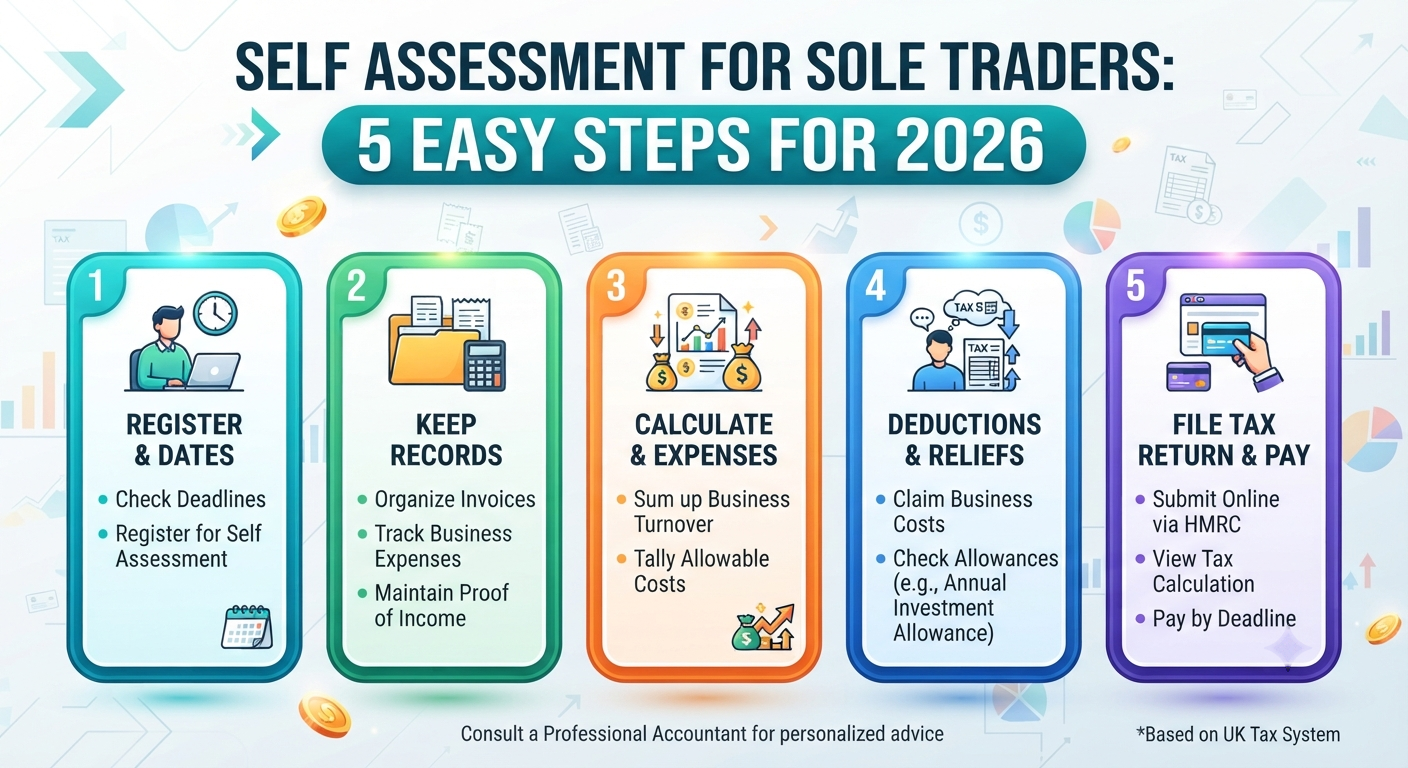
The process can look complicated at first, but breaking it into five simple steps makes it much easier:
- Check whether you need to register for Self Assessment.
- Keep accurate records of your income and expenses.
- Calculate your taxable business profit.
- Complete and submit your Self Assessment tax return.
- Calculate and pay your tax bill on time.
This guide explains each step and shows how sole traders can stay organised throughout the 2026 tax year.
Key Takeaways
- Sole traders report their business profits through Self Assessment.
- The UK tax year runs from 6 April to 5 April.
- If you need to register for Self Assessment for a tax year, the normal registration deadline is 5 October following the end of that tax year.
- Online Self Assessment tax returns are generally due by 31 January following the end of the tax year.
- For the 2025/26 tax year, the online filing and payment deadline is 31 January 2027.
- Payments on account are generally due on 31 January and 31 July when they apply.
- Business income and expenses should be recorded accurately.
- Sole traders generally need to keep their business records for at least 5 years after the relevant 31 January submission deadline.
- Good bookkeeping throughout the year can make Self Assessment much easier.
Quick Answer: What Is Self Assessment for a Sole Trader?
Self Assessment is the HMRC system used to report income and calculate tax for people who have income that is not fully taxed through PAYE.
For sole traders, this normally means reporting:
- Business turnover
- Allowable business expenses
- Business profit
- Other relevant personal income
- Certain tax reliefs or deductions
- National Insurance where applicable
Your tax liability is calculated based on the information submitted to HMRC.
You do not pay tax simply because money enters your business bank account. Instead, your taxable profit is generally based on your business income after the relevant allowable expenses and adjustments.
Who Is This Guide For?
This guide is designed for:
- New sole traders
- Freelancers
- Consultants
- Contractors
- Online business owners
- Self-employed professionals
- Tradespeople
- Small business owners operating as sole traders
- Anyone preparing their first Self Assessment tax return
It can also help existing sole traders who want a simpler way to organise their bookkeeping and tax preparation.
Introduction
Running a sole trader business gives you control over your work, pricing and business decisions.
However, being self-employed also means taking responsibility for your tax administration.
Unlike an employee whose income tax is generally collected through PAYE, a sole trader may need to calculate their business profit, submit a Self Assessment tax return and pay HMRC directly.
The good news is that you do not need to wait until January to start preparing.
Keeping your income and expenses organised throughout the year can make the entire Self Assessment process considerably easier.
The five steps below explain what you need to do.
5 Easy Steps for Self Assessment as a Sole Trader
Step 1: Check If You Need to Register for Self Assessment
The first step is determining whether you need to register with HMRC.
If you are self-employed and need to submit a Self Assessment tax return, you generally need to tell HMRC by 5 October following the end of the relevant tax year.
For example, if you started trading during the 2025/26 tax year, which ended on 5 April 2026, the normal registration deadline would be 5 October 2026.
Example
Imagine you started working as a freelance designer in June 2025.
Your first tax year as a sole trader would include your business activity from June 2025 through 5 April 2026.
If you need to register for Self Assessment, you should normally register by:
5 October 2026
Your online tax return for that tax year would generally be due by:
31 January 2027
Important
Registration and tax-return deadlines are not the same thing.
| Requirement | Typical deadline |
|---|---|
| Register for Self Assessment | 5 October after the tax year |
| Online tax return | 31 January |
| Paper tax return | 31 October |
| Tax payment | 31 January |
| Second payment on account, if applicable | 31 July |
For the 2025/26 tax year, the online return deadline is 31 January 2027, while a paper return is generally due by 31 October 2026.
Step 2: Keep Accurate Records of Income and Expenses
Good bookkeeping is one of the most important parts of Self Assessment.
You need accurate records of your business income and expenses so that you can prepare your tax return correctly. HMRC specifically requires sole traders to keep records of business income and expenses.
Records You May Need Include
- Sales invoices
- Customer payments
- Business bank statements
- Receipts
- Supplier invoices
- Software subscriptions
- Advertising costs
- Business insurance
- Professional fees
- Office costs
- Business travel records
- Mileage records
- Equipment purchases
- Relevant financial records
Keep Business and Personal Transactions Organised
One common mistake is mixing personal and business spending.
For example:
Business expense:
You pay £50 for accounting software used entirely for your business.
Personal expense:
You spend £50 on a personal streaming subscription.
The two should not simply be treated as business expenses because they were paid from the same bank account.
Keeping separate business records makes this distinction much easier.
How Long Should a Sole Trader Keep Records?
Sole traders generally need to keep records for at least 5 years after the 31 January submission deadline for the relevant tax year.
For example, if you submit your 2025/26 tax return by 31 January 2027, your records generally need to be kept until at least the end of January 2032.
Simple Record-Keeping System
A practical system could look like this:
Every week
- Record sales
- Record expenses
- Upload receipts
- Reconcile your bank account
Every month
- Review income
- Review expenses
- Check unpaid invoices
- Check business mileage
- Estimate your profit
Before filing
- Review the entire tax year
- Check your figures
- Organise supporting documents
- Calculate your estimated tax liability
Step 3: Calculate Your Taxable Business Profit
This is where bookkeeping becomes particularly important.
A simple starting point is:
Business income − allowable business expenses = business profit
For example:
| Item | Amount |
|---|---|
| Business income | £45,000 |
| Allowable expenses | £8,000 |
| Approximate business profit | £37,000 |
The £37,000 figure is the business profit before considering the wider tax calculation and any other relevant income, reliefs or adjustments.
Why Profit Matters
You are generally taxed on your taxable income rather than simply the total amount your customers paid you.
That is why recording legitimate business expenses accurately is important.
However, not every payment made by a sole trader is automatically an allowable expense.
Common Sole Trader Expenses
Depending on your circumstances, potentially allowable business costs can include things such as:
Office Costs
- Stationery
- Business phone costs
- Business internet costs
- Office supplies
- Certain home-working costs
Professional Costs
- Accountant fees
- Bookkeeping fees
- Professional advice
- Certain professional memberships
Marketing
- Website costs
- Advertising
- Business cards
- Digital marketing
- Certain promotional expenses
Technology
- Business software
- Cloud storage
- Computer equipment
- Business subscriptions
Travel
- Business mileage
- Public transport for business journeys
- Parking for qualifying business travel
- Certain accommodation costs
The exact tax treatment depends on the nature and purpose of the expense.
What Is an Allowable Expense?
An allowable business expense is a cost that can generally be deducted when calculating taxable business profit, provided it meets the relevant HMRC rules.
The key principle is:
The expense must be incurred for business purposes.
For example, if you operate a graphic design business and purchase specialist design software specifically for your work, that may be a legitimate business expense.
But if you purchase a personal holiday and happen to answer a few business emails during the trip, you should not automatically treat the entire holiday as a business expense.
Step 4: Complete and Submit Your Self Assessment Tax Return
Once your records are organised and your business figures have been calculated, you can prepare your Self Assessment tax return.
For online filing, the normal deadline is 31 January following the end of the tax year.
For the 2025/26 tax year:
Tax year ends: 5 April 2026
Online return deadline: 31 January 2027
Tax payment deadline: 31 January 2027
What Information May Be Required?
Your return can include information such as:
- Business turnover
- Allowable expenses
- Business profit
- Employment income
- Pension income
- Savings income
- Dividends
- Property income
- Capital gains where applicable
- Other taxable income
- Relevant tax reliefs
Not every sole trader will have all of these categories.
Paper vs Online Self Assessment
| Filing method | Typical deadline |
|---|---|
| Paper tax return | 31 October |
| Online tax return | 31 January |
For the 2025/26 tax year, HMRC states that paper returns must generally be received by 31 October 2026, while online returns must generally be submitted by 31 January 2027.
For most sole traders, online filing is the more practical option.
Step 5: Calculate and Pay Your Self Assessment Tax Bill
Submitting your tax return and paying your tax are connected, but they are not exactly the same action.
For most taxpayers, the main Self Assessment payment deadline is 31 January.
For the 2025/26 tax year, the tax payment deadline is 31 January 2027.
However, some sole traders also need to make payments on account.
What Are Payments on Account?
Payments on account are advance payments towards your next Self Assessment tax bill.
They are generally paid in two instalments:
- 31 January
- 31 July
Each payment is normally half of the previous year’s relevant tax bill, subject to the rules that apply to payments on account.
Example
Suppose your previous year’s relevant Self Assessment liability is:
£4,000
Your payments on account could normally be:
31 January: £2,000
31 July: £2,000
If your actual tax liability is higher or lower than expected, a balancing payment or repayment may arise.
Do All Sole Traders Make Payments on Account?
No.
Payments on account do not apply to everyone.
HMRC states that you generally do not have to make payments on account if:
- Your previous year’s tax owed was less than £1,000, or
- More than 80% of the tax you owed was collected outside Self Assessment, subject to the relevant conditions.
Your HMRC Self Assessment statement will show whether payments on account apply to you.
What Happens If You Are Filing Self Assessment for the First Time?
Your first Self Assessment bill can sometimes be larger than expected.
This is because you may need to pay:
- Your tax liability for the previous tax year, and
- Your first payment on account towards the next tax year.
Example
Suppose your first Self Assessment tax bill is:
£3,000
If payments on account apply, you could potentially have:
£3,000 — balancing payment
plus
£1,500 — first payment on account
Total due:
£4,500
The second payment on account would normally be another:
£1,500
This is one reason why new sole traders should start saving for tax early.
Self Assessment Deadline Calendar for 2026/27
Here is a simple calendar to help sole traders stay organised.
| Date | What it means |
|---|---|
| 6 April 2026 | Start of 2026/27 tax year |
| 5 October 2026 | Typical registration deadline for those who need to register for 2025/26 |
| 31 October 2026 | Paper return deadline for 2025/26 |
| 30 December 2026 | Deadline for certain taxpayers wanting tax collected through PAYE coding |
| 31 January 2027 | Online return and main payment deadline for 2025/26 |
| 31 July 2027 | Second payment on account, where applicable |
The exact deadline can depend on your circumstances, so check your HMRC account if you are unsure.
What Happens If You Miss the Self Assessment Deadline?
Missing a Self Assessment deadline can result in penalties and interest.
For example, HMRC states that an online tax return submitted after the deadline can result in a late filing penalty.
That means waiting until the last day is risky.
Better Approach
Instead of working towards 31 January, consider using an earlier internal deadline.
For example:
1 October: finish bookkeeping
1 November: review expenses
1 December: calculate estimated tax
15 December: prepare return
Early January: submit and arrange payment
31 January: official deadline
This gives you a buffer if something goes wrong.
Common Self Assessment Mistakes Sole Traders Make
1. Leaving Bookkeeping Until January
Trying to reconstruct an entire year’s transactions just before filing can create unnecessary stress.
Better Approach
Update your records monthly.
2. Treating Every Purchase as a Business Expense
Buying something through a business bank account does not automatically make it an allowable business expense.
Always consider the business purpose and applicable HMRC rules.
3. Forgetting Small Expenses
Small purchases can add up.
Examples include:
- Software subscriptions
- Stationery
- Business mileage
- Professional subscriptions
- Online services
Keep records throughout the year rather than relying on memory.
4. Forgetting Payments on Account
Some new sole traders are surprised when HMRC requires an additional payment towards the next tax bill.
Planning only for the first tax bill can therefore leave a cash-flow gap.
5. Mixing Business and Personal Spending
This makes bookkeeping harder and increases the risk of recording incorrect expenses.
A separate business bank account can make transaction tracking easier.
6. Missing the Registration Deadline
If you need to register for Self Assessment, do not wait until you are ready to file the tax return.
Registration has its own deadline.
How Much Should a Sole Trader Save for Tax?
There is no universal percentage that applies to every sole trader.
Your tax liability depends on factors such as:
- Taxable profit
- Other income
- Personal circumstances
- Tax allowances
- National Insurance position
- Tax reliefs
- Payments already made
A practical approach is to regularly transfer part of your business income into a separate savings account.
Example
If your business generates £5,000 of monthly sales, you could move an amount into a tax savings account every month based on your estimated liability.
Then, when your Self Assessment bill arrives, you are less likely to face a cash-flow problem.
How Bookkeeping Helps With Self Assessment
Good bookkeeping does more than keep your records tidy.
It helps you understand:
- How much you are earning
- How much you are spending
- Your estimated profit
- Your cash position
- Your expected tax bill
- Which invoices remain unpaid
- Whether your business is growing
Monthly Bookkeeping Checklist
At the end of each month:
- Reconcile your bank account
- Record all sales
- Record all business expenses
- Upload receipts
- Check unpaid invoices
- Review business mileage
- Check software subscriptions
- Update your estimated profit
- Review your tax savings
This makes year-end tax preparation much easier.
Can Accounting Software Help Sole Traders?
Yes.
Accounting software can help you organise:
- Sales invoices
- Expenses
- Receipts
- Bank transactions
- Mileage
- Profit and loss
- Tax estimates
- Financial reports
However, software does not remove the need to understand what should and should not be reported.
The quality of your Self Assessment depends on the accuracy of the information entered.
Self Assessment Example for a Sole Trader
Let’s look at a simple example.
Imagine Sarah runs a freelance marketing business.
During the tax year:
Business income: £50,000
Business expenses: £10,000
Approximate business profit:
£40,000
Sarah keeps:
- Business bank statements
- Sales invoices
- Expense receipts
- Software invoices
- Mileage records
- Accountant invoices
She then uses those records to prepare her Self Assessment return.
Her actual tax liability will depend on her complete tax position, not simply the £40,000 profit figure.
This is why sole traders should avoid estimating tax based only on turnover.
Sole Trader vs Limited Company: Self Assessment Difference
It is important not to confuse sole trader taxation with limited company taxation.
| Sole Trader | Limited Company |
|---|---|
| Business and owner are not separate legal entities in the same way as a company | Company is a separate legal entity |
| Business profit is reported through Self Assessment | Company generally files a Corporation Tax return |
| Owner may pay Income Tax and National Insurance | Company pays Corporation Tax on taxable profits |
| Owner reports relevant personal income | Directors may have separate personal tax obligations |
| Simpler structure for many small businesses | More formal accounting and filing requirements |
If you operate through a limited company, you should not simply follow sole trader Self Assessment rules for the company itself.
What Records Should Sole Traders Keep?
A useful record-keeping system should include:
Income Records
- Sales invoices
- Customer receipts
- Bank deposits
- Payment platform statements
- Other business income
Expense Records
- Supplier invoices
- Receipts
- Bank transactions
- Software subscriptions
- Travel records
- Mileage records
- Professional fees
Other Records
- Bank statements
- Loan records
- Asset purchases
- VAT records, if VAT registered
- Payroll records, if applicable
- Previous tax returns
HMRC requires sole traders to retain appropriate records for the required period.
What Should You Do Before Filing Your Self Assessment?
Before submitting your return, check:
Income
- Have all sales been recorded?
- Have you included other relevant income?
- Have you checked your bank statements?
Expenses
- Have all legitimate business expenses been recorded?
- Do you have supporting receipts?
- Have personal expenses been excluded?
Tax
- Have you checked your previous tax payments?
- Do payments on account apply?
- Have you budgeted for the January payment?
Final Review
- Do the figures match your bookkeeping?
- Have you checked unusual transactions?
- Have you kept supporting records?
A final review can catch simple errors before you submit.
2026 Self Assessment Checklist for Sole Traders
Use this checklist throughout the year:
Registration
☐ Check whether you need to register
☐ Register with HMRC if required
☐ Keep your UTR safely
Bookkeeping
☐ Record business income
☐ Record business expenses
☐ Keep receipts
☐ Reconcile your bank account
☐ Track mileage
Tax Preparation
☐ Calculate estimated profit
☐ Estimate your tax liability
☐ Save money towards your tax bill
☐ Check whether payments on account apply
Filing
☐ Prepare your Self Assessment return
☐ Review all figures
☐ Submit online by the deadline
☐ Pay the tax due
☐ Check whether a payment on account is required
Records
☐ Keep records for the required period
☐ Store digital receipts securely
☐ Keep copies of important tax documents
Frequently Asked Questions
1. What is Self Assessment for a sole trader?
Self Assessment is HMRC’s system for reporting taxable income and calculating the tax owed by people who need to submit a tax return. Sole traders commonly use Self Assessment to report their business profits.
2. When is the Self Assessment deadline for 2026?
For the 2025/26 tax year, the online Self Assessment tax return and tax payment deadline is generally 31 January 2027.
3. When does a sole trader need to register for Self Assessment?
If you need to register, the normal deadline is 5 October following the end of the relevant tax year.
4. What is the deadline for a paper Self Assessment tax return?
The normal paper filing deadline is 31 October following the end of the tax year. For the 2025/26 tax year, this is 31 October 2026.
5. What are payments on account?
Payments on account are advance payments towards your next Self Assessment tax bill. They are generally due on 31 January and 31 July.
6. Do all sole traders have to make payments on account?
No. Payments on account do not apply in every case. HMRC provides conditions under which payments on account are not required, including certain cases where the previous year’s tax liability was below £1,000 or most of the tax was already collected outside Self Assessment.
7. How long should a sole trader keep tax records?
Sole traders generally need to keep records for at least five years after the relevant 31 January submission deadline.
8. Can a sole trader claim business expenses?
Yes, qualifying business expenses can generally be deducted when calculating taxable business profit, provided they meet the applicable rules.
9. Can I file my Self Assessment early?
Yes. You do not have to wait until the deadline. Filing earlier can help you understand how much tax you owe and give you more time to budget for the payment.
10. What happens if I cannot afford my Self Assessment tax bill?
If you cannot pay your tax bill, HMRC may offer payment arrangements in eligible circumstances. Do not simply ignore the bill; check your options with HMRC as soon as possible.
11. Can bookkeeping software help with Self Assessment?
Yes. Accounting software can help organise income, expenses, receipts and financial reports, making it easier to prepare your tax return.
12. Should a sole trader use an accountant?
Not every sole trader needs an accountant, but professional help can be useful if your business has complex expenses, multiple income sources, VAT obligations, property income, capital gains or other complicated tax issues.
When Should a Sole Trader Speak to an Accountant?
Consider professional advice if:
- Your business income has increased significantly
- You have several sources of income
- You are unsure which expenses are allowable
- You have started employing people
- You are considering incorporating
- You have VAT obligations
- You have purchased expensive equipment
- You have property income
- You have capital gains
- You have missed a tax deadline
- You cannot afford your tax bill
- Your bookkeeping has become difficult to manage
An accountant can also help you compare operating as a sole trader with forming a limited company.
Final Verdict
Self Assessment does not have to be stressful.
The easiest way to stay on top of your sole trader tax obligations is to avoid leaving everything until January.
Follow these five steps:
1. Register when required.
2. Keep accurate income and expense records.
3. Calculate your business profit correctly.
4. Submit your Self Assessment tax return on time.
5. Budget for and pay your tax bill and any payments on account.
For the 2025/26 tax year, the online Self Assessment deadline and main payment deadline are generally 31 January 2027. Payments on account, where applicable, are generally due on 31 January and 31 July.
The biggest advantage comes from good bookkeeping throughout the year. When your income, expenses, receipts and bank transactions are already organised, preparing your Self Assessment becomes much simpler.
If you are unsure about your tax position or have complicated business finances, getting professional accounting advice before the deadline can help you avoid unnecessary mistakes.