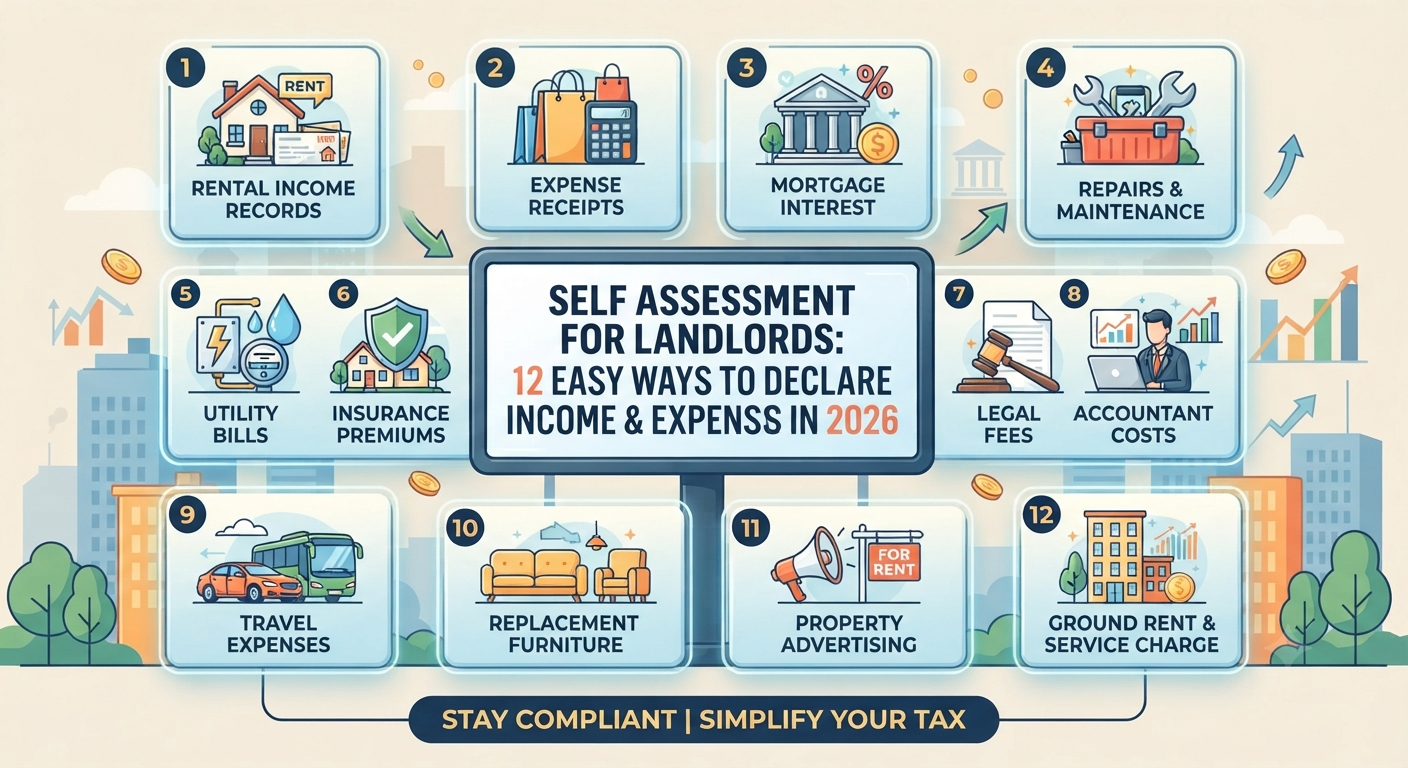
Self Assessment for Landlords: 12 Easy Tips
Quick Summary
If you receive rental income from property you personally own, you may need to declare that income to HMRC through Self Assessment.
For the 2025/26 tax year, landlords need to understand which rental income must be reported, which property expenses are allowable, how mortgage interest is treated, when the tax return is due, and whether Making Tax Digital for Income Tax applies to them.
For many landlords, the basic calculation is:
Rental income − allowable expenses = property profit
However, residential mortgage finance costs have special tax treatment, and landlords may also need to consider the £1,000 property allowance, jointly owned property, overseas property, losses and other sources of income.
This guide explains 12 easy ways to manage Self Assessment for landlords in 2026.
Key Takeaways
- Rental income may need to be declared through Self Assessment.
- The property allowance can provide up to £1,000 of tax-free property income, subject to the rules.
- Common allowable expenses can include letting-agent fees, insurance, repairs, certain legal fees, utilities and professional fees.
- Repairs and improvements are treated differently for tax purposes.
- Residential mortgage interest is generally not deducted from rental income in the normal way; instead, eligible finance costs can qualify for a basic-rate tax reduction.
- UK properties owned personally are generally treated as one UK property business for tax purposes.
- Overseas property income has separate reporting considerations.
- The online Self Assessment deadline for the 2025/26 tax year is 31 January 2027.
- Payments on account may mean you have additional tax payments due on 31 July.
- Making Tax Digital for Income Tax began affecting landlords with qualifying income over £50,000 from 6 April 2026.
- Keeping organised records throughout the year makes tax reporting much easier.
- Professional advice can be particularly useful if you own multiple properties, have a mortgage, own property jointly or have overseas rental income.
Quick Answer: Do Landlords Need to Complete a Self Assessment?
Not every landlord automatically needs to complete a Self Assessment tax return.
The reporting requirement depends on factors including the amount and type of property income you receive and whether you have other reasons to submit a tax return.
HMRC states that property income over certain thresholds may need to be reported. If your gross property income is more than £1,000, you may need to contact HMRC or register for Self Assessment depending on the amount and your circumstances.
For example, HMRC currently states that landlords generally need to report property income on Self Assessment if it is more than £2,500 after allowable expenses or £10,000 before allowable expenses.
The exact position can vary, so landlords should check HMRC’s current guidance before deciding that no return is required.
Who Is This Guide For?
This guide is designed for individuals who receive income from property, including:
- Buy-to-let landlords
- Residential landlords
- Landlords with one rental property
- Landlords with multiple properties
- People renting out a property they personally own
- Joint property owners
- Landlords with rental income alongside employment income
- Landlords with UK and overseas property income
- New landlords preparing for their first Self Assessment
- Existing landlords who want a simpler bookkeeping process
This article focuses primarily on individual landlords, rather than limited companies that own rental properties.
Introduction: Self Assessment for Landlords Explained
Becoming a landlord can create an additional source of income, but rental income also creates tax responsibilities.
A common mistake is to think that HMRC simply taxes the rent you receive.
In reality, landlords generally calculate their property profit by taking eligible property income and deducting allowable expenses.
For example:
Rental income: £18,000
Allowable expenses: £4,000
Property profit: £14,000
However, the calculation can become more complicated when you introduce:
- Mortgage interest
- Property improvements
- Joint ownership
- Property allowance
- Property losses
- Overseas properties
- Multiple properties
- Other personal income
- Making Tax Digital
That is why good bookkeeping is important.
12 Easy Ways to Handle Self Assessment for Landlords
1. Check Whether You Need to Declare Your Rental Income
The first step is determining whether your property income needs to be reported to HMRC.
HMRC’s property guidance states that the first £1,000 of property income may qualify for the property allowance, subject to eligibility rules. If gross property income is above £1,000, different reporting rules can apply.
HMRC also states that landlords generally need to report property income through Self Assessment where it is more than:
- £2,500 after allowable expenses, or
- £10,000 before allowable expenses.
If you are unsure whether you need to file, check HMRC’s current guidance rather than assuming that a small rental income means no tax return is required.
Example
Suppose you receive:
- £12,000 annual rent
- £3,000 allowable expenses
Your gross rental income is £12,000, while your property profit is £9,000.
Because the gross amount exceeds £10,000, this is clearly within the range where HMRC says you generally need to report the income.
2. Keep a Separate Record of All Rental Income
Good landlord bookkeeping starts with recording every amount received.
Your records may include:
- Monthly rent
- Rent paid in advance
- Tenant payments
- Premiums
- Certain lease-related payments
- Insurance-related receipts
- Other taxable property receipts
Do not rely solely on your bank statement.
Create a dedicated rental-income record so you can easily reconcile your figures when completing your tax return.
Simple Rental Income Tracker
| Date | Property | Tenant/Reference | Amount |
|---|---|---|---|
| 05/04/2026 | Flat A | Monthly rent | £1,200 |
| 05/05/2026 | Flat A | Monthly rent | £1,200 |
| 05/06/2026 | Flat A | Monthly rent | £1,200 |
| 05/07/2026 | Flat A | Monthly rent | £1,200 |
At the end of the year, you can total the income instead of searching through individual transactions.
3. Understand the £1,000 Property Allowance
The property allowance can provide up to £1,000 of tax-free property income for eligible individuals.
However, you cannot normally claim the property allowance and also deduct your actual property expenses for the same income.
HMRC explains that if gross property income is more than £1,000, landlords may choose between the property allowance and calculating profit using allowable expenses, depending on their circumstances.
Example
Suppose your gross rental income is:
£8,000
And your actual allowable expenses are:
£3,500
You could compare:
Actual expense method
£8,000 − £3,500 = £4,500
versus the property allowance:
£8,000 − £1,000 = £7,000
In this simplified example, claiming actual expenses would produce the lower taxable property profit.
This is why landlords should not automatically assume that the £1,000 property allowance is the best option.
4. Know Which Landlord Expenses Are Allowable
One of the most important parts of Self Assessment for landlords is understanding allowable expenses.
For residential property, HMRC lists examples including:
- Letting-agent fees
- Certain legal fees
- Accountant fees
- Buildings and contents insurance
- Repairs and maintenance
- Utilities
- Rent, ground rent and service charges
- Council Tax
- Cleaning
- Gardening and other services
These expenses generally need to relate to the day-to-day running of the property.
Common Allowable Landlord Expenses
| Expense | Usually deductible? |
|---|---|
| Letting agent fees | Generally yes |
| Property insurance | Generally yes |
| Accountant fees relating to property | Generally yes |
| Repairs | Generally yes |
| Cleaning | Generally yes |
| Gardening | Generally yes |
| Council Tax paid by landlord | Generally yes |
| Utilities paid by landlord | Generally yes |
| Ground rent | Generally yes |
| Service charges | Generally yes |
| Mortgage interest | Special rules apply |
| Property improvements | Generally not as a normal revenue expense |
Always check the specific circumstances before claiming an expense.
5. Separate Repairs From Improvements
This is one of the most important distinctions for landlords.
A repair generally restores something that already exists.
An improvement generally changes or upgrades the property beyond its original condition.
Example of a Repair
A boiler breaks and you replace it with a modern equivalent.
This may qualify as a repair expense, depending on the circumstances.
Example of an Improvement
You replace a basic kitchen with a significantly superior, higher-specification kitchen.
The tax treatment may be different because the work could represent an improvement rather than an ordinary repair.
Do not automatically treat every building-related cost as a deductible rental expense.
Keep invoices and supporting documents explaining what work was actually carried out.
6. Understand How Mortgage Interest Is Treated
Mortgage interest is an area where many individual residential landlords make mistakes.
Since the tax rules were fully phased in from April 2020, individual landlords generally cannot simply deduct residential property finance costs from rental income in the same way as other allowable expenses.
Instead, eligible finance costs are generally taken into account through a basic-rate tax reduction.
Finance costs can include qualifying interest on:
- Mortgages
- Loans
- Overdrafts
- Certain finance arrangements
- Certain fees associated with obtaining or repaying loans
The restriction applies to individual residential landlords, while companies are treated differently.
Why This Matters
Suppose you receive:
£20,000 rent
and have:
£6,000 mortgage interest
You should not simply calculate:
£20,000 − £6,000 = £14,000 taxable rental profit
That can produce an incorrect result for an individual residential landlord.
The finance-cost tax reduction has its own rules and limits.
7. Record Income and Expenses for Every Property
If you own several rental properties, keeping one large collection of receipts can become difficult.
Create a clear system.
For example:
Property A
- Rental income
- Repairs
- Insurance
- Agent fees
- Utilities
- Service charges
- Council Tax
Property B
- Rental income
- Repairs
- Insurance
- Agent fees
- Utilities
- Service charges
- Council Tax
Even though UK properties generally form part of one UK property business for tax purposes, maintaining property-level records can make your bookkeeping and review process much easier. HMRC confirms that UK properties are generally treated as one UK property business.
8. Know the Self Assessment Deadlines
For the 2025/26 tax year, the online Self Assessment deadline is:
31 January 2027
The paper return deadline is:
31 October 2026
The tax owed is also generally due by:
31 January 2027
If payments on account apply, there is a second payment deadline on:
31 July 2027
Important Landlord Tax Calendar
| Date | What it means |
|---|---|
| 6 April 2025 | 2025/26 tax year begins |
| 5 April 2026 | 2025/26 tax year ends |
| 6 April 2026 | 2026/27 tax year begins |
| 31 October 2026 | Paper Self Assessment deadline |
| 31 January 2027 | Online return + tax payment deadline |
| 31 July 2027 | Second payment on account, where applicable |
Do not wait until January to start gathering your records.
9. Understand Payments on Account
A landlord’s first Self Assessment bill can sometimes be larger than expected because HMRC may require payments on account.
Payments on account are advance payments towards your next tax bill.
Where they apply, they are generally due:
- 31 January
- 31 July
Each payment is usually based on half of the previous year’s relevant tax liability.
Simple Example
Suppose your Self Assessment liability is:
£4,000
You may have:
31 January: £4,000 balancing payment + £2,000 payment on account
31 July: £2,000 payment on account
This can make the first Self Assessment bill feel much larger than expected.
That is why landlords should budget for both the current tax liability and possible payments on account.
10. Prepare the Correct Property Information for Your Tax Return
When completing Self Assessment, you need accurate information about your property income and expenses.
For UK property income, HMRC provides the SA105 UK property supplementary pages. The 2026 version is available for the 2025/26 tax year.
Depending on your circumstances, you may need information such as:
- Total rental income
- Property expenses
- Property finance costs
- Property allowance information
- Property losses
- Joint ownership details
- Other property-related income
- Relevant adjustments
If you have overseas property, the reporting process is different. HMRC states that SA105 should not be used to declare overseas property income.
11. Check Whether Making Tax Digital Applies to You
Making Tax Digital for Income Tax is an important change for landlords in 2026.
From 6 April 2026, landlords and sole traders with qualifying income above £50,000 are required to use Making Tax Digital for Income Tax, subject to the rules and exemptions.
Qualifying income is based on gross income from property and self-employment before expenses.
HMRC’s staged timetable is:
| Tax year used to determine qualifying income | Qualifying income | MTD start |
|---|---|---|
| 2024/25 | Over £50,000 | 6 April 2026 |
| 2025/26 | Over £30,000 | 6 April 2027 |
| 2026/27 | Over £20,000 | 6 April 2028 |
What Does MTD Mean for Landlords?
If you are required to use it, you will need compatible software to:
- Keep digital property records
- Record income and expenses
- Send quarterly updates to HMRC
- Submit your tax return
- Pay the tax due
HMRC has confirmed that from September 2026 it will begin signing up eligible landlords who have not already signed up for the 2026/27 tax year.
This makes good digital bookkeeping increasingly important for landlords.
12. Keep Your Records Organised Throughout the Year
The easiest way to make Self Assessment less stressful is to avoid doing everything at the last minute.
Create a monthly bookkeeping routine.
Every Month
Record:
- Rent received
- Repairs
- Insurance
- Letting-agent fees
- Utility costs
- Service charges
- Council Tax
- Professional fees
- Mortgage finance costs
- Other relevant property expenses
Every Quarter
Review:
- Bank transactions
- Missing invoices
- Rental payments
- Property expenses
- Mortgage statements
- Agent statements
- Property-level records
Before Filing
Check:
- Total rental income
- Total allowable expenses
- Property profit/loss
- Finance costs
- Property allowance position
- Previous-year losses
- Other personal income
- Payments on account
Good bookkeeping reduces the chance of missing an expense or accidentally claiming something that is not allowable.
What Income Do Landlords Need to Declare?
Rental income can come from different sources.
Depending on the circumstances, landlords may need to consider:
Residential Rent
The most common example is rent received from a tenant living in a residential property.
Furnished Accommodation
Income from furnished rooms or properties can have specific tax rules.
Lease Premiums
Certain premiums connected with leasing UK land can have tax implications.
Overseas Rental Income
If you own property outside the UK, the income may need to be declared separately.
Other Property Receipts
Certain other payments associated with property can also be taxable.
HMRC’s property Self Assessment guidance specifically identifies UK and overseas property rental income, furnished rooms and certain lease-related receipts as areas landlords may need to report.
What Expenses Can Landlords Claim?
A useful way to think about expenses is to divide them into categories.
Property Management
Examples include:
- Letting-agent fees
- Property management fees
- Tenant finding fees
- Professional management services
Repairs and Maintenance
Examples include:
- Fixing plumbing
- Repairing electrical systems
- Replacing damaged fixtures
- Decorating
- General maintenance
Insurance
Examples include:
- Buildings insurance
- Contents insurance
- Landlord insurance
Professional Fees
Examples include:
- Accountant fees
- Certain legal fees
- Professional property advice
Property Running Costs
Depending on the circumstances:
- Council Tax
- Utilities
- Cleaning
- Gardening
- Ground rent
- Service charges
HMRC confirms several of these categories as examples of allowable day-to-day property expenses.
What Landlord Expenses Are Usually Not Deductible as Normal Revenue Expenses?
Landlords should be careful with costs that are capital in nature.
Examples can include:
- Buying the property itself
- Major capital improvements
- Certain property extensions
- Certain structural alterations
- Personal expenditure
- Costs unrelated to the rental business
This does not necessarily mean that a capital cost has no tax relevance.
It may have a different tax treatment from an ordinary revenue expense.
Therefore, do not simply put every property-related payment into the expenses section of your Self Assessment.
Self Assessment Example for a Landlord
Let’s look at a simplified example.
Sarah owns one residential rental property.
During the year she receives:
Rental income: £18,000
Her eligible day-to-day property expenses include:
- Letting agent: £1,800
- Insurance: £400
- Repairs: £700
- Service charges: £600
- Accountant: £300
Total allowable expenses:
£3,800
Simplified property profit:
£18,000 − £3,800 = £14,200
Sarah also paid qualifying mortgage interest during the year.
She should not simply deduct the mortgage interest from the £14,200 in the same way as the other expenses. Instead, the residential finance-cost rules need to be applied to determine any available tax reduction.
This example is simplified because the final tax calculation also depends on Sarah’s wider income, allowances, tax bands and other circumstances.
What If a Landlord Makes a Loss?
A property business can sometimes make a loss.
For example:
Rental income: £10,000
Allowable expenses: £13,000
Simplified property loss:
£3,000
Property losses have specific rules.
HMRC explains that losses can generally be carried forward against future profits of the same property business, subject to the applicable rules.
This is another reason why landlords should maintain accurate records even during years when the property does not make a profit.
What If You Own a Property Jointly?
Joint property ownership requires careful record keeping.
For example, suppose two people own a rental property equally.
If the property generates:
£20,000 rental income
and the ownership split is 50/50, each person’s share may generally need to be considered separately for their tax position, subject to the relevant rules and ownership arrangements.
HMRC also states that joint property owners can each potentially qualify for the £1,000 property allowance against their share of gross rental income, where the allowance rules are met.
Do not assume that the entire rental income belongs on one person’s tax return simply because one person manages the property.
What About Overseas Rental Property?
UK landlords who own property overseas may have additional reporting obligations.
Foreign property income is not simply treated in exactly the same way as UK property income.
HMRC treats UK and non-UK properties as separate property businesses for certain purposes, and overseas property income is not reported on the SA105 UK property pages.
You may also need to consider:
- Foreign tax paid
- Double taxation rules
- Exchange rates
- Foreign property expenses
- Local filing obligations
If you own overseas property, professional tax advice can be particularly valuable.
Landlord Bookkeeping Checklist
Use this checklist throughout the tax year.
Income
- Record every rent payment
- Keep letting-agent statements
- Record other property receipts
- Reconcile rental income with bank statements
Expenses
- Save repair invoices
- Record insurance
- Record agent fees
- Record service charges
- Record Council Tax where applicable
- Record utilities where applicable
- Record professional fees
- Keep mortgage statements
Tax
- Check whether Self Assessment applies
- Check property allowance eligibility
- Calculate property profit
- Review finance-cost treatment
- Check property losses
- Check payments on account
- Check whether MTD applies
Filing
- Prepare property figures
- Complete relevant Self Assessment sections
- Check figures against your records
- Submit before the deadline
- Pay tax on time
Common Self Assessment Mistakes Landlords Make
Mistake 1: Declaring Rent but Forgetting Expenses
Some landlords focus only on rental income and forget legitimate property costs.
Solution: Maintain a monthly expense tracker.
Mistake 2: Claiming Every Property Cost as an Expense
Not every property-related cost is an allowable revenue expense.
Solution: Separate repairs, improvements and capital costs.
Mistake 3: Treating Mortgage Interest Like a Normal Expense
Individual residential landlords have special finance-cost rules.
Solution: Keep mortgage finance costs separate and apply the relevant tax reduction rules.
Mistake 4: Assuming the £1,000 Property Allowance Is Always Better
The property allowance may be less beneficial than claiming actual allowable expenses.
Solution: Compare both methods before making a claim.
Mistake 5: Waiting Until January
Trying to reconstruct an entire year’s rental records immediately before filing can lead to errors.
Solution: Update your records monthly.
Mistake 6: Ignoring Making Tax Digital
Landlords above the relevant qualifying-income threshold may now have digital reporting obligations.
Solution: Check the current MTD timetable and prepare compatible software if required.
How Bookkeeping Makes Self Assessment Easier
Good bookkeeping is not just about keeping HMRC happy.
It gives landlords a clearer picture of how each property is performing.
You can see:
- Total rent
- Total expenses
- Property profit
- Mortgage costs
- Repair costs
- Management costs
- Cash flow
- Outstanding tenant payments
It also makes your accountant’s job easier.
Instead of handing over a bank statement containing hundreds of transactions, you can provide an organised income and expense report.
Can Accounting Software Help Landlords?
Yes.
Accounting or property bookkeeping software can help you:
- Record rental income
- Categorise expenses
- Store digital records
- Reconcile bank transactions
- Track multiple properties
- Produce reports
- Prepare information for your tax return
Software is particularly useful if you have multiple properties or need to comply with Making Tax Digital.
If you are required to use MTD for Income Tax, HMRC requires compatible software for digital records and quarterly updates.
When Should a Landlord Hire an Accountant?
You may want professional advice if you:
- Own several rental properties
- Have significant mortgage finance costs
- Own property jointly
- Have overseas property
- Have property losses
- Are buying or selling property
- Are considering transferring property
- Own property through a company
- Have employment and rental income
- Have received HMRC correspondence
- Are unsure about your tax return
- Need help with Making Tax Digital
An accountant can help identify tax issues that are easy to overlook when managing everything yourself.
2026 Self Assessment Checklist for Landlords
Before submitting your tax return, ask yourself:
Income
- Have I included all rental income?
- Have I checked my bank statements?
- Have I checked letting-agent statements?
- Have I considered other property receipts?
Expenses
- Have I recorded all allowable expenses?
- Do I have invoices and receipts?
- Have I separated repairs from improvements?
- Have I treated mortgage finance costs correctly?
Property
- Do I own the property personally?
- Is it jointly owned?
- Do I own other UK properties?
- Do I own overseas property?
Tax
- Do I qualify for the property allowance?
- Is claiming actual expenses better?
- Do I have property losses?
- Do payments on account apply?
- Does Making Tax Digital apply to me?
Filing
- Is my return complete?
- Have I checked the figures?
- Have I submitted before the deadline?
- Have I budgeted for the tax payment?
Frequently Asked Questions
Do Landlords Have to Complete a Self Assessment?
Not every landlord necessarily needs to complete a Self Assessment tax return. The requirement depends on the level and type of property income and other circumstances. HMRC provides specific thresholds and guidance for property income reporting.
How Much Rental Income Can I Receive Before Paying Tax?
The £1,000 property allowance can provide tax-free property income for eligible individuals, but this does not mean every landlord with income above £1,000 will necessarily pay tax on the full amount. You need to consider your expenses, allowance choice and wider tax position.
What Expenses Can Landlords Claim?
Common allowable expenses can include letting-agent fees, insurance, repairs, certain legal and professional fees, utilities, Council Tax, ground rent, service charges, cleaning and gardening, where the relevant conditions are met.
Can Landlords Claim Mortgage Interest?
Individual residential landlords generally receive tax relief on eligible residential finance costs through a basic-rate tax reduction rather than deducting the full finance cost from rental income in the normal way.
What Is the Self Assessment Deadline for Landlords?
For the 2025/26 tax year, the online Self Assessment return and tax payment deadline is 31 January 2027. The paper return deadline is 31 October 2026.
What Is the Property Allowance?
The property allowance is a tax-free allowance of up to £1,000 for eligible property income. If you use the allowance, you generally cannot also deduct actual expenses against the same property income.
Can I Claim Repairs Against Rental Income?
Eligible repairs and maintenance can generally be deductible expenses when they relate to the day-to-day running of the rental property. Improvements are treated differently and should not automatically be claimed as ordinary repair expenses.
What Happens If I Make a Rental Property Loss?
Property losses are subject to specific rules. HMRC generally allows qualifying losses to be carried forward against future profits of the same property business, subject to the applicable conditions.
Do Landlords Need Making Tax Digital in 2026?
Some landlords do. From 6 April 2026, landlords and sole traders with qualifying income over £50,000 are required to use Making Tax Digital for Income Tax, subject to exemptions and the applicable rules.
What Records Should Landlords Keep?
Landlords should keep records supporting rental income, expenses and tax calculations, including bank statements, invoices, receipts, agent statements and mortgage information where relevant. If you use MTD, digital record-keeping requirements also apply.
Can I Manage Self Assessment Myself?
Yes, many landlords manage their own bookkeeping and Self Assessment. However, professional advice can be useful if you have multiple properties, complex finance arrangements, overseas property, joint ownership, property losses or other complicated tax circumstances.
Final Verdict: Make Self Assessment Easier With Good Landlord Bookkeeping
Self Assessment for landlords does not have to be complicated.
The key is to understand what income you need to declare, record your expenses accurately and understand the special rules that apply to property income.
The most important areas to get right are:
- Rental income
- Allowable expenses
- Property allowance
- Repairs versus improvements
- Mortgage finance costs
- Property losses
- Joint ownership
- Overseas property
- Self Assessment deadlines
- Payments on account
- Making Tax Digital
- Accurate bookkeeping
For the 2025/26 tax year, landlords should work towards the 31 January 2027 online Self Assessment deadline and make sure their records are complete well before filing.
And if your qualifying property and self-employment income means you fall within Making Tax Digital, 2026 is an especially important year to move towards reliable digital record keeping.
Good landlord bookkeeping means fewer surprises, easier tax returns and better visibility over your property profits.