RTI Payroll: Rules & Deadlines for 2026
If you employ staff in the UK, you need to report payroll information to HM Revenue and Customs (HMRC) through Real Time Information (RTI).
RTI payroll reporting allows HMRC to receive information about employees’ pay, tax and National Insurance deductions each time you run payroll.
Unlike the old system of reporting payroll information once a year, RTI requires employers to report employee payment information regularly throughout the tax year.
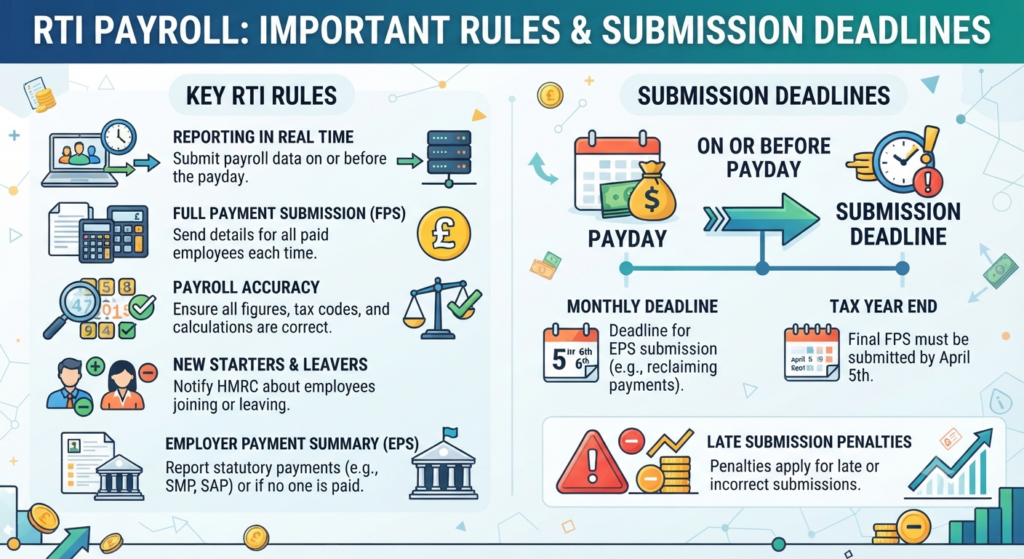
For most employers, this means submitting a Full Payment Submission (FPS) to HMRC on or before each payday. An Employer Payment Summary (EPS) may also be needed in certain situations.
Understanding RTI payroll deadlines is important because late or incorrect submissions can result in penalties and payroll problems.
This guide explains what RTI payroll is, when you must submit it, what FPS and EPS mean, what information you need to report, and what happens if you submit late.
Quick Summary
| RTI Payroll Requirement | What You Need to Know |
|---|---|
| RTI | Real Time Information reporting to HMRC |
| FPS | Reports employee pay and deductions |
| FPS deadline | Generally on or before payday |
| EPS | Used for additional payroll information or where no employees were paid |
| EPS deadline | Generally by the 19th of the following tax month |
| Who submits it? | Employers running PAYE payroll |
| Software | HMRC-recognised payroll software is normally used |
| Late filing | Can result in penalties |
| Incorrect information | May need a corrected submission |
The key rule to remember is:
Your FPS should normally be submitted to HMRC on or before the day you pay your employees.
What Is RTI Payroll?
RTI stands for Real Time Information.
It is HMRC’s system for collecting information about employee payments and deductions from employers.
When you run payroll, you calculate things such as:
- Gross pay
- Income Tax
- National Insurance
- Student loan deductions
- Workplace pension information
- Statutory payments
- Other relevant payroll deductions
You then use payroll software to send the required information to HMRC.
The main report is the Full Payment Submission (FPS).
HMRC uses RTI information to help maintain accurate PAYE records and calculate the tax position of employees.
What Does RTI Mean?
RTI means Real Time Information because payroll information is reported to HMRC when employees are paid rather than waiting until the end of the tax year.
For example, if your employees are paid monthly on the 28th, you generally submit the FPS on or before the 28th.
If employees are paid weekly, you generally submit an FPS every week.
The reporting frequency therefore normally follows your payroll payment schedule.
HMRC states that employers must submit an FPS each time they pay employees, whether they are paid weekly, monthly or on another normal payroll schedule.
What Is an FPS?
FPS stands for Full Payment Submission.
It is the main RTI report employers send to HMRC.
The FPS tells HMRC about payments made to employees and the deductions taken from those payments.
An FPS can contain information such as:
- Employer PAYE reference
- Employee details
- Employee pay
- Income Tax deductions
- National Insurance deductions
- Student loan deductions where applicable
- Statutory payments
- Payroll information relevant to HMRC
You generally send an FPS each time employees are paid.
When Must You Submit an FPS?
The standard rule is straightforward:
Send the FPS on or before your employees’ payday.
For example:
| Payday | Normal FPS deadline |
|---|---|
| 5 April | 5 April |
| 15 April | 15 April |
| 25 April | 25 April |
| 30 April | 30 April |
If you normally pay employees on the 25th of every month, the FPS should generally be submitted on or before the 25th.
HMRC also says that if you pay employees early because the normal payday falls on a bank holiday, you should generally enter the usual payday date in the FPS rather than changing it simply because payment was made early.
Can You Submit an FPS Early?
Yes.
You can submit an FPS before the normal payday.
For example, if your payroll administrator will be away when payroll is due, you may submit the FPS earlier.
However, HMRC warns against reporting too early if the payroll information could still change. If something changes after an early FPS, you may need to send a corrected submission.
A good approach is to complete payroll calculations first, check them carefully and then submit the FPS.
What Is an EPS?
EPS stands for Employer Payment Summary.
An EPS is different from an FPS.
An FPS mainly reports employee payments and deductions.
An EPS is used to provide additional information to HMRC that can affect what an employer owes under PAYE.
You may need to submit an EPS if, for example, you:
- Claim Employment Allowance
- Reclaim certain statutory payments
- Reclaim CIS deductions as a limited company
- Pay the Apprenticeship Levy
- Have not paid any employees during a tax month
HMRC provides specific circumstances where an EPS should be submitted.
When Is an EPS Due?
The normal EPS deadline is:
19th of the following tax month.
For example, if an EPS relates to information for a tax month ending 5 May, it should generally be submitted by 19 May where needed.
The EPS deadline is therefore different from the FPS deadline.
Simple Comparison
FPS: On or before payday
EPS: Generally by the 19th of the following tax month
What If You Did Not Pay Any Employees?
If you did not pay any employees during a tax month, you generally do not send an FPS for that month.
Instead, you should send an EPS indicating that no FPS is due.
HMRC guidance says an EPS should be sent if you have not paid any employees in a tax month.
This is important because simply doing nothing can leave HMRC expecting payroll information that has not been submitted.
FPS vs EPS: What’s the Difference?
| Feature | FPS | EPS |
|---|---|---|
| Full name | Full Payment Submission | Employer Payment Summary |
| Main purpose | Reports employee pay and deductions | Reports additional payroll information |
| Normal timing | On or before payday | Generally by 19th of following tax month |
| Used every payday? | Generally yes | Only when required |
| No employees paid? | No FPS normally required | EPS can report no payment |
| Employment Allowance | Not normally reported here | Yes |
| Statutory payment recovery | Not normally the main report | Yes |
| CIS deductions for limited company | No | Yes |
What Information Is Reported Through RTI?
RTI payroll reporting can include a range of employer and employee information.
This may include:
Employer Information
- Employer PAYE reference
- HMRC office number
- Accounts Office reference
- Relevant tax year
- Other employer details
Employee Information
- Name
- Date of birth
- National Insurance number
- Address
- Employee payroll information
Pay Information
- Gross pay
- Taxable pay
- Income Tax
- National Insurance
- Student loan deductions where applicable
- Other relevant deductions
HMRC’s payroll reporting guidance sets out the information employers need to include in FPS and EPS submissions.
Does Every Employee Need to Be Included?
Generally, yes.
HMRC says employers should include everyone they pay in the FPS, even where the employee receives less than £96 per week.
This means you should not assume that a small payment automatically means the employee can be left off the RTI submission.
RTI Payroll Example
Imagine a small business has three employees.
They are paid on the last working day of every month.
The employer runs payroll and calculates:
- Gross salaries
- Income Tax
- Employee National Insurance
- Employer National Insurance
- Pension deductions
The employer then sends the FPS to HMRC on or before the normal payday.
If the employer also needs to report information through an EPS, that submission is normally sent by the 19th of the following tax month.
This process repeats throughout the tax year.
What Happens If You Submit RTI Late?
Late RTI submissions can result in penalties.
HMRC’s current guidance states that an employer can be liable for a penalty where one or more RTI returns are not filed by the filing date.
The standard fixed late-filing penalty depends on the number of employees in the PAYE scheme.
| Number of employees | Penalty |
|---|---|
| 1 to 9 | £100 |
| 10 to 49 | £200 |
| 50 to 249 | £300 |
| 250 or more | £400 |
There is generally an unpenalised first default in each tax year for many employers, although exceptions apply, including certain annual PAYE schemes.
Repeated or extended failures can lead to additional penalties.
What If RTI Is More Than 3 Months Late?
HMRC may charge an additional penalty where an RTI failure continues beyond three months.
The extended failure penalty can be 5% of the relevant PAYE, National Insurance and student loan liability that should have been reported on the missing return or returns. HMRC says this discretionary penalty is generally reserved for serious or persistent failures.
This is why it is important to correct missing RTI submissions as soon as possible.
What If You Have a Reason for Filing Late?
There can be circumstances where an employer has a reasonable excuse for a late submission.
If you have a genuine reason for missing the deadline, you should still submit the outstanding RTI information without unreasonable delay.
HMRC guidance recognises reasonable-excuse circumstances when considering late-filing penalties.
Do not deliberately wait until the next payroll period if you know an RTI submission is overdue.
What If You Make a Mistake on Your FPS?
Payroll mistakes can happen.
For example, you may discover that:
- An employee’s tax code was wrong
- Salary was entered incorrectly
- National Insurance was calculated incorrectly
- An employee’s personal details were incorrect
- A deduction was missed
- The wrong payment information was submitted
The correct action depends on the type of error and when you discover it.
In many cases, payroll software can be used to make a correction or submit updated information to HMRC.
Do not simply ignore an incorrect FPS.
Keeping payroll records accurate helps ensure that employee tax records and your PAYE account are correct.
What If You Pay Employees Early?
Sometimes businesses pay employees early because the normal payday falls on:
- A bank holiday
- Christmas
- A business closure
- Another special circumstance
HMRC says you should generally enter the employee’s usual payday in the FPS even if you actually pay them earlier because the normal payday falls on a bank holiday.
For example:
Normal payday: 27 December
Actual payment date because of a bank holiday: 23 December
The usual payday should generally still be reported rather than changing the payroll date simply because you paid employees early.
What Is the RTI Tax Month?
PAYE operates using tax months that run from the 6th of one month to the 5th of the next month.
For example:
6 April to 5 May = Tax Month 1
6 May to 5 June = Tax Month 2
This matters when dealing with EPS deadlines and PAYE payment obligations.
The RTI filing deadline for an FPS, however, is normally linked to the employee’s payday rather than the end of the tax month.
RTI Payroll and PAYE Payments
RTI reporting and PAYE payments are related but they are not the same thing.
The FPS tells HMRC what you paid employees and what deductions were made.
You then need to pay the PAYE and National Insurance amounts due to HMRC by the relevant payment deadline.
For many employers paying monthly, PAYE payments are generally due by the 22nd of the following tax month when paying electronically.
Smaller employers who are eligible to pay quarterly have different payment arrangements.
Always check the current HMRC payment deadline that applies to your PAYE scheme.
Late PAYE payments can result in penalties and interest.
RTI Payroll and New Employees
When you hire a new employee, you need to collect the information required to run payroll correctly.
This can include:
- Full name
- Date of birth
- Address
- National Insurance number
- Starter information
- Tax code information
- Payment details
The employee should then be included in your payroll and reported through RTI when you make their first payment.
HMRC’s payroll guidance explains the information employers need to report for new employees.
RTI Payroll When an Employee Leaves
When an employee leaves, you should update your payroll records and include the relevant leaving information in your final payment submission for that employee.
Your payroll software will normally guide you through the required fields.
Keeping leaving dates and final pay information accurate is important because HMRC uses RTI information to update the employee’s PAYE record.
RTI Payroll at the End of the Tax Year
The UK tax year ends on 5 April.
At the end of the tax year, employers need to complete their final payroll reporting correctly.
Your final FPS should generally be submitted on or before the employees’ last payday of the tax year.
You should also mark the final submission for the year where required by your payroll software.
If you did not pay anyone in the final pay period, an EPS may be needed instead in certain circumstances.
RTI Payroll Checklist for Employers
Before submitting your payroll, check:
- Employee names are correct
- National Insurance numbers are correct
- Tax codes have been checked
- Gross pay is correct
- Income Tax is correct
- National Insurance is correct
- Pension deductions are correct
- Student loan deductions are correct where applicable
- Statutory payments are recorded correctly
- Employee leaving dates are correct
- FPS payment date is correct
- FPS has been submitted on time
- EPS has been submitted where required
- PAYE payment deadline has been checked
- Payroll records have been saved
Common RTI Payroll Mistakes
1. Submitting the FPS After Payday
The normal rule is to submit the FPS on or before payday.
Submitting it after payday can create a late-filing issue.
2. Confusing FPS and EPS
An FPS and EPS serve different purposes.
Make sure you know which report your payroll situation requires.
3. Forgetting the EPS
If you have not paid employees during a tax month, you may need to submit an EPS instead of an FPS.
4. Reporting the Wrong Payday
The FPS should generally contain the normal payday, even where employees were paid early because of a bank holiday.
5. Ignoring Payroll Errors
If you discover an incorrect submission, review the appropriate correction process rather than leaving the error unresolved.
6. Forgetting PAYE Payments
Submitting RTI does not automatically mean your PAYE bill has been paid.
You must separately make the payment to HMRC.
7. Leaving Payroll Until the Last Minute
Running payroll just before payday increases the risk of mistakes and missed deadlines.
How to Make RTI Payroll Easier
A simple payroll routine can reduce errors.
Step 1: Collect Employee Information
Make sure you have accurate employee records.
Step 2: Calculate Payroll
Calculate gross pay, tax, National Insurance and other deductions.
Step 3: Review the Payroll
Check unusual changes, new employees, leavers, bonuses and deductions.
Step 4: Submit the FPS
Send the FPS to HMRC on or before payday.
Step 5: Submit the EPS if Required
Check whether an EPS is needed and submit it by the relevant deadline.
Step 6: Pay HMRC
Check the PAYE payment amount and payment deadline.
Step 7: Keep Records
Save payroll reports, payslips and submission confirmations.
Can You Use Payroll Software for RTI?
Yes.
Most employers use payroll software to calculate payroll and submit RTI information electronically.
Your software should help calculate:
- PAYE
- National Insurance
- Employee deductions
- Employer National Insurance
- Pension deductions
- Statutory payments
It can also generate and submit the relevant FPS and EPS reports.
Using software does not remove the employer’s responsibility for checking the information.
You should still review your payroll before submitting it.
Should a Small Business Outsource RTI Payroll?
Not every business needs to run payroll itself.
You may consider using an accountant or payroll provider if:
- You have several employees
- Payroll is becoming complicated
- You have frequent new starters and leavers
- You have statutory payments
- You operate multiple payrolls
- You are worried about RTI deadlines
- You do not understand PAYE calculations
- You want to reduce payroll administration
The important thing is that RTI submissions are accurate and made on time.
RTI Payroll 2026: Important Dates to Remember
For most employers, there is not one single annual RTI deadline.
Instead, deadlines occur throughout the year.
FPS
On or before each payday.
EPS
Generally by the 19th of the following tax month when an EPS is required.
Tax Year End
5 April
Final FPS
On or before the final payday of the tax year.
These deadlines are based on the current HMRC payroll reporting rules.
RTI Payroll Example for a Small Business
Imagine a company has five employees.
Employees are paid monthly on the 25th.
The employer runs payroll on the 23rd.
23rd
Payroll calculations are completed and checked.
24th
The employer reviews the payroll and prepares the FPS.
25th
Employees are paid.
The FPS should have been submitted to HMRC on or before the 25th.
If the employer needs to submit an EPS, it should generally be submitted by the 19th of the following tax month.
This simple schedule gives the business some time to identify and correct mistakes before payday.
RTI Payroll vs Traditional Payroll Reporting
Before RTI, employers generally reported payroll information through annual returns.
RTI changed the process by requiring employers to send payroll information during the year.
| Old approach | RTI approach |
|---|---|
| Mainly annual reporting | Regular reporting |
| Information sent after the year | Information sent when employees are paid |
| Less frequent HMRC updates | Regular HMRC updates |
| Annual payroll reconciliation | Ongoing payroll reporting |
RTI therefore makes payroll reporting a regular part of running payroll rather than an annual task.
Frequently Asked Questions
What Is RTI Payroll?
RTI payroll stands for Real Time Information payroll reporting. It is the system employers use to report employee pay and deductions to HMRC.
When Must an FPS Be Submitted?
An FPS should generally be submitted to HMRC on or before the day employees are paid.
What Is an EPS?
An EPS is an Employer Payment Summary. It is used to report certain information to HMRC that can affect the PAYE amount an employer owes, and it can also be used when no employees were paid during a tax month.
When Is an EPS Due?
An EPS is generally due by the 19th of the following tax month when one is required.
What Happens If I Submit an FPS Late?
You may receive a late-filing penalty. The standard fixed penalty depends on the number of employees in your PAYE scheme.
Can I Submit an FPS Early?
Yes. HMRC allows employers to submit an FPS before payday, although you should avoid submitting it too early if payroll information may change.
Do I Need to Submit an FPS If I Did Not Pay Anyone?
If you did not pay any employees in a tax month, you generally send an EPS instead of an FPS to report that no FPS is due.
Do Small Businesses Need RTI Payroll?
If you employ people and operate PAYE, you generally need to report payroll information through RTI regardless of whether your business is small.
Does RTI Automatically Pay HMRC?
No. Sending an FPS or EPS is a reporting requirement. You must separately pay the PAYE and National Insurance amounts due to HMRC.
What Is the Difference Between RTI and PAYE?
PAYE is the system for collecting Income Tax and National Insurance from employment. RTI is the reporting system used by employers to send payroll information to HMRC.
Can an Accountant Submit RTI for Me?
Yes. An accountant or payroll provider can often run payroll and submit RTI on your behalf. However, you should make sure they have the correct employee and payroll information.
How Often Do I Submit RTI?
Usually, you submit an FPS each time you pay employees. Therefore, weekly payroll generally means weekly FPS submissions, while monthly payroll generally means monthly FPS submissions.
Final Thoughts
RTI payroll is an essential part of running PAYE for UK employers.
The main rule is simple: when you pay employees, you normally need to report their pay and deductions to HMRC through an FPS on or before payday.
You may also need to submit an EPS, particularly when claiming certain reductions or statutory payments, reclaiming CIS deductions as a limited company, or when no employees were paid during a tax month.
Keeping your payroll records accurate, checking your submissions before sending them and staying aware of RTI deadlines can help prevent unnecessary penalties.
For a small business, having a consistent payroll process—or using professional payroll support—can make RTI reporting much easier and reduce the risk of missed deadlines.