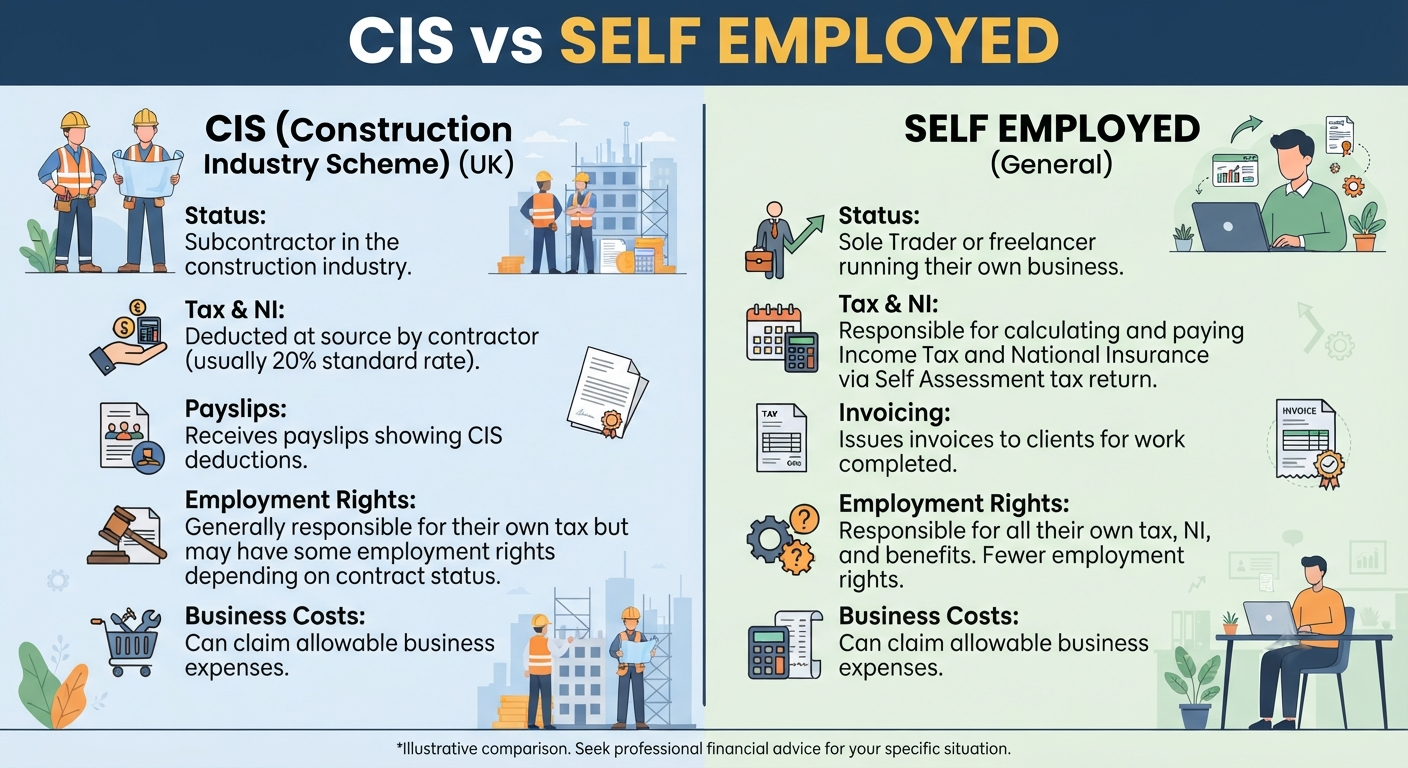
CIS vs Self Employed: Key Differences 2026
If you work in construction, you may have heard both CIS and self-employed used to describe how you work and how you pay tax. But they are not actually the same thing.
The Construction Industry Scheme (CIS) is a system used by contractors to handle tax deductions from payments to subcontractors. Being self-employed describes your employment status and means you run your own business and are responsible for its success or failure.
This distinction is important because you can be self-employed and work under CIS at the same time. HMRC confirms that CIS applies to certain construction contracts involving self-employed subcontractors, but being registered for CIS does not automatically prove that someone is self-employed.
In this guide, we explain the key differences between CIS vs self-employed, how tax deductions work, what happens with Self Assessment, and what construction workers should know in 2026.
Quick Summary
| CIS | Self-Employed |
|---|---|
| A tax deduction scheme for construction work | An employment/business status |
| Mainly affects how contractors handle payments | Determines how you run and report your business |
| Usually involves CIS deductions from payments | Usually involves paying your own Income Tax and National Insurance |
| Can apply to sole traders, partnerships and companies | Can apply to sole traders and business owners |
| Standard CIS deduction is usually 20% | There is no standard self-employed deduction rate |
| 30% may apply if the subcontractor is not registered/verified | Tax is normally calculated based on taxable profits |
| 0% deduction may apply with gross payment status | You remain responsible for your tax obligations |
The most important point is simple:
CIS is a tax deduction scheme. Self-employed is a working status.
What Is CIS?
CIS stands for Construction Industry Scheme.
The scheme applies to certain payments made by contractors to subcontractors for construction work.
Under CIS, the contractor normally deducts money from the subcontractor’s payment and sends the deduction to HMRC. The deduction counts as an advance payment towards the subcontractor’s tax and National Insurance liabilities.
Construction work covered by CIS can include activities such as:
- Construction
- Site preparation
- Alterations
- Repairs
- Decorating
- Demolition
- Dismantling
- Refurbishment
The scheme can cover different types of businesses, including sole traders, partnerships and companies.
Example
Imagine you are a self-employed electrician working as a subcontractor for a construction company.
You invoice the contractor for £3,000.
If you are registered and verified under CIS, the contractor may make a 20% CIS deduction from the amount subject to CIS.
That deduction is not simply an additional business expense.
It is a payment made to HMRC on your behalf towards your tax and National Insurance liabilities.
What Does Self-Employed Mean?
Being self-employed means you run your own business and take responsibility for its success or failure.
According to GOV.UK, self-employed workers are generally not paid through PAYE and do not have the same employment rights and responsibilities as employees.
A self-employed person may:
- Find their own clients
- Agree prices for work
- Send invoices
- Keep business records
- Pay their own tax
- Claim allowable business expenses
- Decide how and when they work, subject to their contracts
- Take responsibility for business costs and risks
For example, a self-employed plumber might work for several contractors throughout the year and invoice each contractor for completed work.
If the work falls within CIS, those contractors may deduct CIS tax from the payments.
So the same person can be:
Self-employed + CIS subcontractor
There is no contradiction between the two.
CIS vs Self Employed: What Is the Main Difference?
The biggest difference is that CIS describes how certain construction payments are taxed, while self-employed describes your working status.
Think of it this way:
Self-employed = how you work
CIS = how tax may be deducted from certain construction payments
This is why asking whether you are “CIS or self-employed” can sometimes be misleading.
You may actually be both.
CIS vs Self Employed Comparison
| Area | CIS | Self-Employed |
|---|---|---|
| What is it? | Construction tax deduction scheme | Business/employment status |
| Mainly applies to | Construction contractors and subcontractors | People running their own businesses |
| Tax deducted from payments? | Usually yes, unless gross payment status applies | Usually no automatic deduction simply because you are self-employed |
| Standard CIS rate | 20% for registered/verified subcontractors | No fixed deduction rate |
| Higher CIS rate | 30% if the subcontractor is not registered/verified | Not applicable as a general self-employed rate |
| Gross payment status | Possible for qualifying CIS subcontractors | Not the same as self-employed status |
| Tax return | Depends on business structure | Sole traders/partners generally use Self Assessment |
| Business expenses | Relevant | Relevant |
| Employment rights | Depends on actual employment status | Generally fewer employment rights than employees |
| HMRC registration | CIS registration may be required | Self Assessment/business registration may be required |
| Can they overlap? | Yes | Yes |
Is CIS the Same as Being Self-Employed?
No.
CIS and self-employed status are separate concepts.
A person can be registered for CIS but that does not automatically mean every contract they work on is self-employed.
HMRC specifically states that being registered as a CIS subcontractor is not proof of self-employed status. Employment status must be considered based on the particular engagement.
This is extremely important for contractors.
If someone should actually be treated as an employee, PAYE may need to be operated instead of CIS.
How CIS Tax Deductions Work
For a registered and verified CIS subcontractor, the standard deduction rate is generally 20%.
If the subcontractor cannot be verified or is not registered, the deduction can be 30%.
If the subcontractor has gross payment status, the contractor does not normally deduct CIS tax from the payment.
CIS deduction rates
| Status | CIS deduction |
|---|---|
| Registered and verified | 20% |
| Not registered/verified | 30% |
| Gross payment status | 0% |
These percentages should not be confused with your final tax rate.
A 20% CIS deduction does not necessarily mean you ultimately owe exactly 20% tax.
CIS deductions are advance payments towards your tax and National Insurance liabilities.
Example: Self-Employed Worker Under CIS
Suppose a self-employed builder completes construction work for a contractor.
The invoice is £4,000.
Assume the amount subject to CIS after the relevant exclusions is £4,000.
At a 20% CIS deduction:
£4,000 × 20% = £800
The contractor pays:
£4,000 − £800 = £3,200
The £800 deduction is reported to HMRC as a CIS deduction.
At the end of the tax year, the subcontractor reports the relevant income and CIS deductions through their tax return. HMRC takes the CIS deductions into account when calculating the final tax position.
Does CIS Mean You Do Not Need to Pay Tax?
No.
This is one of the most common misunderstandings.
CIS deductions are advance payments, not necessarily your final tax bill.
Your final tax position depends on factors such as:
- Total business income
- Allowable business expenses
- Taxable profit
- Personal circumstances
- Income from other sources
- National Insurance liabilities
- CIS deductions already made
For a sole trader or partner, CIS deductions are reported through Self Assessment and HMRC calculates the final position.
You could therefore:
- Have more tax to pay
- Receive a refund
- Have little or no additional tax to pay
depending on your overall circumstances.
CIS and Self Assessment
If you are a self-employed CIS subcontractor operating as a sole trader or partner, you generally need to report your income and CIS deductions through Self Assessment.
HMRC says you should record:
- Your total pay before CIS deductions as income
- The total CIS deductions taken by contractors as CIS deductions
HMRC then takes those deductions into account when working out how much tax you owe.
Example
You earned:
£30,000 gross income
Your contractors deducted:
£6,000 CIS
You do not normally report only the £24,000 you received in your bank account as your business income.
Instead, the gross income and CIS deductions need to be reported correctly.
This is why keeping your CIS payment and deduction statements is important.
What Is Gross Payment Status?
Some CIS subcontractors can qualify for gross payment status.
This means contractors can pay them without making CIS deductions.
However, having gross payment status does not mean you are automatically self-employed.
HMRC makes clear that employment status still needs to be considered separately.
Gross payment status has eligibility conditions, including business, turnover and compliance requirements.
For example, HMRC’s current guidance includes turnover tests and requires the business to meet relevant conditions.
If you receive payments gross, you are still responsible for calculating and paying your own tax.
CIS vs Self Employed: Tax Differences
The way tax is handled can look different.
CIS subcontractor
A contractor may deduct CIS tax before paying you.
The deduction is then passed to HMRC.
You later report your income and deductions when completing the appropriate tax return or company tax process.
Self-employed person who is not under CIS
You generally receive your business income without CIS deductions and are responsible for calculating and paying your own tax through the appropriate tax system.
Self-employed CIS subcontractor
You can have both:
Self-employed status + CIS deductions
This is probably the most common situation behind the question “CIS vs self employed”.
What Expenses Can a Self-Employed CIS Worker Claim?
Being paid under CIS does not mean you automatically lose the ability to claim allowable business expenses.
If you are genuinely self-employed, you may be able to claim eligible business expenses when calculating taxable profit.
Examples may include qualifying costs for:
- Tools
- Protective equipment
- Business insurance
- Vehicle and business travel costs
- Professional fees
- Accountancy fees
- Phone and internet used for business
- Business software
- Certain training costs
- Materials and other qualifying business costs
The exact treatment depends on the type of expense and your circumstances.
Keep receipts, invoices and other supporting records.
Can CIS Workers Claim a Tax Refund?
Yes, a CIS subcontractor may receive a tax refund if their CIS deductions are greater than their final tax and National Insurance liabilities after the relevant calculations.
For example, if contractors deducted £5,000 during the year but your final liabilities are lower after considering your taxable profits and allowable expenses, you may be entitled to repayment of some of the excess.
However, a refund is not guaranteed simply because you were paid under CIS.
Your final liability has to be calculated first.
CIS vs Self Employed: What About Employees?
This is another important distinction.
An employee is different from a self-employed subcontractor.
Employees are generally paid through PAYE and may receive employment rights such as:
- Paid holiday
- Statutory payments where applicable
- Workplace pension rights
- Protection under employment law
- Employer-provided equipment in some situations
HMRC lists factors that can indicate employment, including control over how and when work is done, minimum working hours, inability to send a substitute and other characteristics.
However, employment status is based on the actual circumstances of the engagement, not simply what a contract or invoice says.
Can You Be Employed and Self-Employed?
Yes.
You can have an employment job and also operate a separate self-employed business.
For example:
Day job: Employee working for a construction company
Evenings/weekends: Self-employed electrician taking private jobs
GOV.UK confirms that someone can be employed and self-employed at the same time.
If the self-employed work is construction work for a contractor, CIS may also apply to those payments.
Can You Be CIS and Self-Employed at the Same Time?
Yes — absolutely.
This is one of the most important points to remember.
For example:
John is a self-employed bricklayer. He works as a subcontractor for a construction company. The contractor verifies John under CIS and deducts 20% from his qualifying payments.
John is:
- Self-employed
- A CIS subcontractor
- Responsible for his business records
- Responsible for reporting his income
- Subject to CIS deductions
There is no conflict between these descriptions.
What If You Are a Limited Company?
CIS can also apply when a subcontractor operates through a limited company.
This is different from being a sole trader.
For a limited company:
- The company receives the construction income.
- CIS deductions may be made from payments.
- The company has its own tax and accounting responsibilities.
- CIS deductions may be used against relevant company liabilities under HMRC rules.
HMRC provides separate guidance for companies operating as CIS subcontractors.
This means you should not assume that a CIS subcontractor is automatically an individual sole trader.
CIS Sole Trader vs Self-Employed Sole Trader
These terms are often confused.
A sole trader is a type of business structure.
A self-employed person is someone who runs their own business.
A CIS subcontractor is someone whose qualifying construction payments are handled under CIS.
One person can therefore be:
Sole trader + self-employed + CIS subcontractor
For example:
Sarah runs a small plumbing business as a sole trader. She works for construction contractors and receives payments under CIS.
Sarah’s position could be:
- Business structure: Sole trader
- Employment status: Self-employed
- Construction tax scheme: CIS
- Tax return: Self Assessment
What Records Should CIS Subcontractors Keep?
Good record keeping makes CIS and Self Assessment much easier.
Keep:
- CIS payment and deduction statements
- Invoices
- Sales records
- Business bank statements
- Expense receipts
- Mileage records where relevant
- Tool and equipment invoices
- Insurance documents
- Accounting records
- HMRC correspondence
Your CIS deduction statements are particularly important because they help demonstrate how much tax contractors have already deducted.
HMRC says subcontractors need the monthly payment and deduction statements supplied by contractors when reporting CIS deductions.
What If a Contractor Deducts the Wrong CIS Amount?
If you believe a contractor has deducted the wrong amount, check the payment and deduction statement first.
Compare:
- Gross payment
- Materials and other relevant deductions
- CIS deduction rate
- CIS amount deducted
- Net amount paid
If something does not match, contact the contractor and ask them to review the calculation.
Do not simply change the CIS figures on your tax return to make them match your expected amount.
Your tax return should reflect the actual CIS deductions supported by your records.
What If You Are Deducted 30% CIS?
A 30% deduction can apply when a subcontractor is not registered or cannot be verified under CIS.
For example:
Gross amount subject to CIS: £5,000
30% CIS deduction: £1,500
Amount paid: £3,500
The £1,500 is treated as a CIS deduction and can be taken into account when calculating your final tax position.
If you believe you should have been paid at 20%, contact the contractor and check whether your CIS registration and verification details are correct.
Is CIS Better Than Being Self-Employed?
This is not really an either/or choice.
CIS and self-employed status serve different purposes.
If you are a genuine self-employed construction subcontractor, CIS may simply determine how tax is deducted from your payments.
The better question is:
Are you correctly classified as self-employed, and is CIS being applied correctly to your construction payments?
That is more useful than asking whether CIS is “better” than being self-employed.
Common CIS vs Self-Employed Mistakes
1. Thinking CIS automatically means self-employed
It does not.
HMRC specifically says CIS registration is not proof of self-employed status.
2. Treating CIS deductions as expenses
CIS deductions are advance payments towards tax and National Insurance, not ordinary business expenses.
3. Reporting only the money received in your bank
For Self Assessment, CIS subcontractors generally need to report gross income and CIS deductions separately.
4. Forgetting CIS statements
Keep your payment and deduction statements so your records support the figures reported to HMRC.
5. Assuming 20% CIS means 20% final tax
It does not.
The final tax position depends on your overall taxable income, expenses and liabilities.
6. Assuming gross payment status means you are self-employed
Gross payment status only concerns how CIS payments are made. Employment status is a separate question.
7. Ignoring employment status
If a worker should actually be an employee, PAYE may need to apply instead of CIS.
CIS vs Self Employed: Which One Applies to You?
Use this simple guide.
You may be self-employed if:
- You run your own business.
- You invoice customers or contractors.
- You take responsibility for business costs and profits.
- You are not working under a contract of employment.
CIS may apply if:
- You perform qualifying construction work.
- You are paid by a contractor.
- The engagement falls within the CIS rules.
- You are operating as a subcontractor.
You may be both if:
- You are self-employed.
- You work as a construction subcontractor.
- Your contractor pays you under CIS.
You may be an employee instead if:
- Your actual working relationship resembles employment.
- The business controls important aspects of your work.
- You receive employment benefits.
- You are expected to work set hours under the employer’s direction.
- The circumstances indicate a contract of employment.
HMRC’s employment-status guidance should be used where the position is unclear.
Simple Example: CIS vs Self Employed
Let’s compare two workers.
Worker A: Self-employed graphic designer
Tom runs his own graphic design business.
He invoices clients directly and keeps his own business records.
His clients do not deduct CIS because graphic design is not being paid under CIS.
Tom is:
Self-employed
Worker B: Self-employed construction worker
Mike runs his own plastering business.
He works for construction contractors as a subcontractor.
His contractor verifies him under CIS and deducts 20% from qualifying payments.
Mike is:
Self-employed + CIS subcontractor
The difference is that CIS affects the way Mike’s qualifying construction payments are handled.
CIS vs Self Employed: Key Takeaways
The main differences are:
- CIS is a tax deduction scheme.
- Self-employed describes your working/business status.
- You can be self-employed and registered for CIS.
- CIS deductions are normally 20% for registered and verified subcontractors.
- A 30% deduction can apply where the subcontractor is not registered or cannot be verified.
- Gross payment status can allow qualifying subcontractors to receive payments without CIS deductions.
- CIS deductions are generally advance payments towards tax and National Insurance, not your final tax bill.
- Sole trader CIS subcontractors generally report their income and CIS deductions through Self Assessment.
- Being registered for CIS does not automatically prove self-employed status.
- If the relationship is actually employment, PAYE may apply instead of CIS.
CIS vs Self Employed Checklist for 2026
Before completing your tax return, check that you have:
- Confirmed your employment status
- Registered for CIS if required
- Given contractors your correct UTR and business details
- Checked your CIS payment and deduction statements
- Recorded gross business income
- Recorded CIS deductions separately
- Recorded allowable business expenses
- Kept invoices and receipts
- Checked your bank records
- Reviewed your Self Assessment figures
- Checked whether you have any tax still due
- Checked whether you are entitled to a repayment
Frequently Asked Questions
Is CIS the same as being self-employed?
No. CIS is a construction tax deduction scheme, while self-employed describes your working or business status. A person can be both self-employed and a CIS subcontractor.
Can I be self-employed and CIS at the same time?
Yes. This is a common situation for construction workers who operate as self-employed subcontractors.
Does CIS mean I am automatically self-employed?
No. HMRC states that CIS registration does not prove self-employed status. The actual terms and circumstances of the engagement must be considered.
How much CIS tax is normally deducted?
The standard deduction is generally 20% for registered and verified subcontractors. A 30% rate can apply if the subcontractor is not registered or cannot be verified. Gross payment status can mean no CIS deduction is made.
Is CIS deduction my final tax?
No. CIS deductions are advance payments towards your tax and National Insurance liabilities. Your final tax position is calculated based on your overall circumstances.
Do CIS subcontractors need Self Assessment?
Sole traders and partners generally report their income and CIS deductions through Self Assessment at the end of the tax year.
Can I claim expenses if I work under CIS?
If you are genuinely self-employed, qualifying business expenses can generally be taken into account when calculating your taxable profit, subject to the normal rules.
Can I get a CIS tax refund?
You may receive a refund if the CIS deductions already paid to HMRC are greater than your final tax and National Insurance liabilities after the relevant calculations.
Can an employee be paid under CIS?
CIS does not apply to a contract of employment. If the worker is actually an employee, PAYE should generally be considered instead.
Can I have a job and be self-employed?
Yes. Someone can be employed and self-employed at the same time.
What is the easiest way to keep track of CIS?
Keep all CIS statements, invoices, business expenses and bank transactions together. Using bookkeeping software or working with an accountant can also make it easier to reconcile your income and CIS deductions.
Final Thoughts
The difference between CIS vs self-employed is much easier to understand once you separate the two concepts.
Self-employed describes how you work and operate your business.
CIS describes how certain construction payments are handled for tax purposes.
So, if you are a self-employed builder, electrician, plumber, carpenter, decorator or other construction worker, you may be both self-employed and a CIS subcontractor.
The important thing is to make sure your employment status is correct, your CIS deductions are recorded accurately and your tax return reflects your actual income, expenses and deductions.
If you are unsure whether you should be treated as self-employed or an employee, or whether your CIS deductions have been calculated correctly, getting professional accounting advice can help you avoid tax problems and unexpected bills.