Do I Need a Bookkeeper or Accountant? 2026 Easy Guide
Quick Summary
If you run a small business, you may eventually wonder whether you need a bookkeeper, an accountant, or both.
The answer depends on what your business needs.
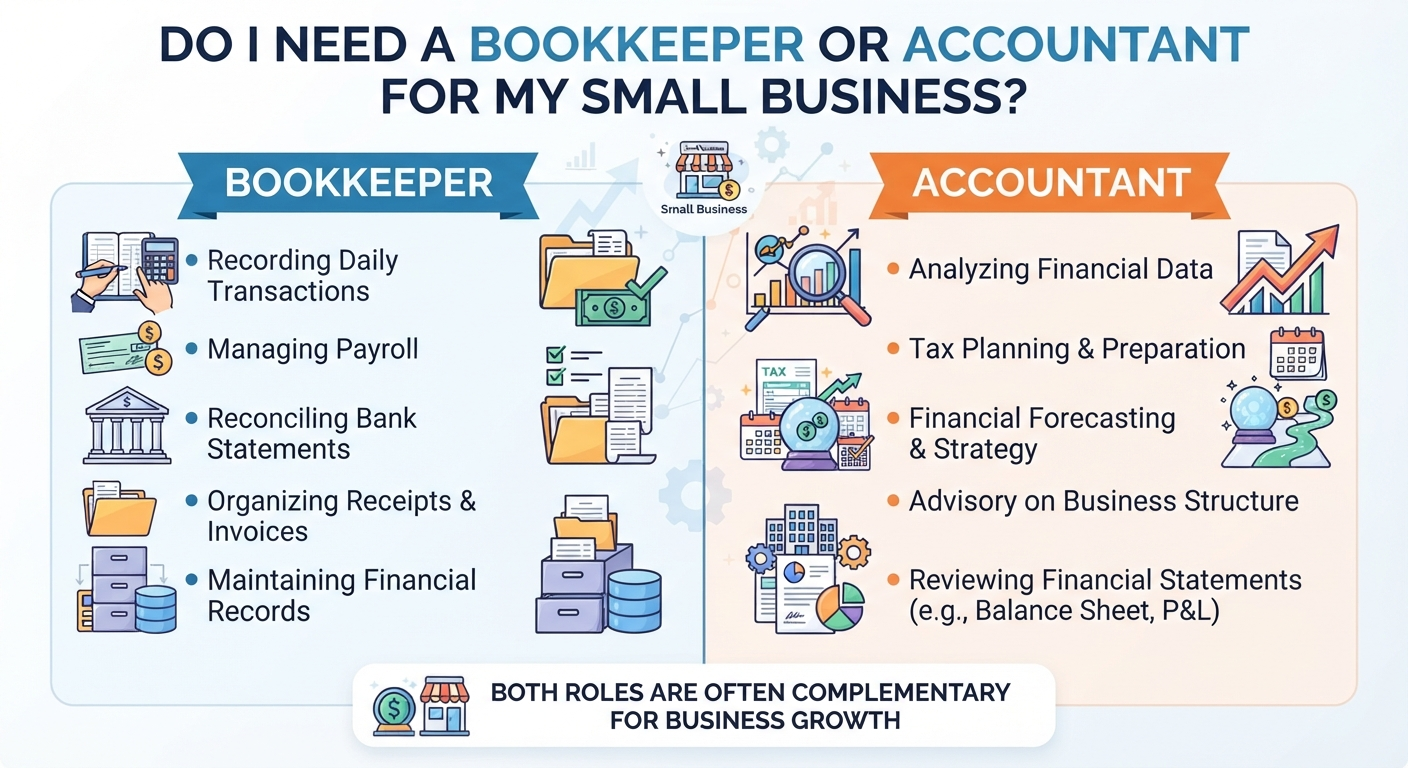
A bookkeeper generally focuses on keeping your financial records organized and up to date, while an accountant can provide broader financial analysis, tax-related support, reporting, planning, and professional advice.
For some small businesses, bookkeeping software may handle basic recordkeeping with occasional professional support. For others, hiring a bookkeeper or accountant can save significant time and help keep financial information organized.
The right choice depends on factors such as:
- Business size
- Number of transactions
- Payroll complexity
- Tax requirements
- Business structure
- Financial reporting needs
- Growth plans
- Your own accounting knowledge
- How much time you have available
- The complexity of your finances
The good news is that you don’t necessarily have to choose only one.
Many small businesses use bookkeeping support for day-to-day records and an accountant for tax, reporting, planning, and more complex financial decisions.
Key Takeaways
- A bookkeeper primarily helps maintain accurate and organized financial records.
- An accountant can provide broader financial analysis, reporting, tax support, and business advice.
- Very small businesses may be able to manage basic bookkeeping themselves.
- Businesses with growing transaction volume may benefit from professional bookkeeping support.
- Tax complexity is an important reason to consider working with an accountant.
- Hiring a bookkeeper and accountant can make sense when your business becomes more financially complex.
- Bookkeeping software can reduce manual work but does not necessarily replace professional advice.
- Your business structure and financial obligations can affect the type of professional help you need.
- Rapid business growth is a good reason to reconsider your current bookkeeping and accounting setup.
- The cheapest option is not always the most practical option.
- A professional can potentially save you time by taking repetitive financial tasks off your plate.
- You can start with limited professional support and increase it as your business grows.
Quick Answer: Do I Need a Bookkeeper or Accountant for My Small Business?
You may need a bookkeeper, an accountant, or both depending on your business’s financial complexity and your own ability to manage the records accurately.
A simple way to think about it is:
Bookkeeper → Keeps financial records organized
Accountant → Helps interpret, report, plan, and advise on financial matters
For example, a small business owner with only a few monthly transactions may be comfortable handling basic bookkeeping with accounting software.
A growing business with hundreds of transactions, employees, inventory, multiple accounts, or complicated financial reporting may benefit from professional bookkeeping.
An accountant may become particularly valuable when you need help with tax preparation, financial statements, business planning, financial analysis, or more complicated accounting matters.
You don’t necessarily need to hire a full-time employee.
Depending on your circumstances, you could use:
- DIY bookkeeping
- Bookkeeping software
- A freelance bookkeeper
- A part-time bookkeeper
- An outsourced accounting service
- An accountant
- A combination of bookkeeping and accounting services
The goal is to choose the level of support that matches your business.
Who Is This Guide For?
This guide is useful for small business owners who are asking:
- Do I need a bookkeeper?
- Do I need an accountant?
- What’s the difference between a bookkeeper and accountant?
- Can I do my own bookkeeping?
- When should I hire a bookkeeper?
- When should I hire an accountant?
- Do I need both a bookkeeper and accountant?
- Is accounting software enough for my business?
- How do I know when my finances have become too complicated?
- Should I outsource bookkeeping?
- What financial tasks should I handle myself?
- How can professional accounting support help my business?
It can be especially useful if your business is growing and you’re spending more time dealing with financial records than running the business itself.
Introduction
Running a small business involves much more than selling products or services.
You also have to keep track of income, expenses, invoices, payments, receipts, accounts, financial records, and potentially tax-related information.
At the beginning, this may seem manageable.
You might have only a handful of transactions each month, a simple bank account, and relatively few expenses.
So you may reasonably think:
“Why would I pay someone to do this when I can do it myself?”
That’s a fair question.
But as your business grows, financial administration can become increasingly time-consuming and complicated.
You may suddenly have:
- More customers
- More invoices
- More expenses
- Multiple bank accounts
- Employees
- Payroll
- Inventory
- Business loans
- Contractors
- Recurring subscriptions
- Larger transactions
- More financial reports
- More tax-related responsibilities
At that point, the question changes.
Instead of asking:
“Can I do my bookkeeping myself?”
You may want to ask:
“Is doing my bookkeeping myself still the best use of my time?”
That’s where a bookkeeper or accountant can become valuable.
In this guide, we’ll explain the differences between bookkeeping and accounting, when you may need professional help, and how to decide what makes sense for your small business in 2026.
What Is the Difference Between a Bookkeeper and an Accountant?
The terms bookkeeper and accountant are sometimes used interchangeably, but they generally refer to different types of financial work.
What Does a Bookkeeper Do?
A bookkeeper generally focuses on maintaining financial records.
Typical bookkeeping tasks can include:
- Recording business transactions
- Categorizing income and expenses
- Reconciling bank accounts
- Managing accounts receivable records
- Managing accounts payable records
- Recording invoices
- Tracking payments
- Maintaining organized financial records
- Preparing basic financial information
The primary goal is to make sure your financial records are accurate, organized, and up to date.
What Does an Accountant Do?
Accounting generally goes beyond recording transactions.
Depending on their role and qualifications, an accountant may help with:
- Financial statements
- Financial analysis
- Tax-related work
- Business planning
- Budgeting
- Forecasting
- Financial reporting
- Accounting adjustments
- Business structure considerations
- Interpreting financial information
- Strategic financial decisions
The exact services vary by professional and jurisdiction.
Simple Difference
| Bookkeeper | Accountant |
|---|---|
| Records transactions | Analyzes financial information |
| Organizes financial records | Helps interpret financial results |
| Reconciles accounts | May prepare or review financial statements |
| Tracks invoices and payments | May assist with tax and financial planning |
| Maintains day-to-day records | Provides broader financial insight |
| Focuses heavily on recordkeeping | Focuses more heavily on analysis, reporting, and advice |
There can be overlap between the two roles.
A small business may also work with a professional who provides both bookkeeping and accounting services.
Do I Need a Bookkeeper for My Small Business?
Not every small business needs a professional bookkeeper immediately.
If your business is very simple, you may be able to maintain your own records using accounting software and a consistent bookkeeping process.
However, professional bookkeeping can become valuable when your financial activity increases.
You May Benefit From a Bookkeeper If:
- You have a growing number of transactions
- You’re spending hours every week on bookkeeping
- Your records are falling behind
- You frequently lose receipts or invoices
- You have multiple business accounts
- You have employees or contractors
- You sell through multiple channels
- Your inventory is becoming more complicated
- You struggle to reconcile accounts
- You aren’t confident that your records are accurate
- You need regular financial reports
- You spend more time on bookkeeping than you think it’s worth
A bookkeeper can take recurring administrative work off your plate.
That can allow you to spend more time on sales, customers, operations, marketing, and growth.
Do I Need an Accountant for My Small Business?
An accountant may be useful when your business needs go beyond basic recordkeeping.
For example, you may want professional accounting support when you need to understand what your financial numbers actually mean.
An accountant may help you evaluate:
- Revenue
- Expenses
- Profitability
- Cash flow
- Financial performance
- Budgets
- Forecasts
- Business decisions
- Tax-related matters
- Financial reporting
Consider an Accountant If:
- Your business is growing quickly
- Your financial situation is becoming complicated
- You need financial statements
- You need help understanding financial performance
- You’re dealing with more complex tax matters
- You’re considering major business decisions
- You’re preparing for financing
- You’re considering bringing in investors
- You’re buying or selling a business
- You want professional financial advice
An accountant can potentially help you move beyond simply recording what happened to understanding why it happened and what you might do next.
Do I Need Both a Bookkeeper and an Accountant?
You might.
In fact, many growing businesses can benefit from having both functions covered.
Think of the relationship like this:
Bookkeeper → Keeps the numbers organized
Accountant → Helps you understand and use those numbers
For example, your bookkeeper may maintain your transaction records throughout the year.
Your accountant may then use those records to help with financial reporting, tax-related work, analysis, or planning.
Example
Imagine your business generates more revenue this year but your cash balance isn’t increasing as expected.
Your bookkeeping records can show:
- Revenue
- Expenses
- Customer payments
- Supplier payments
- Bank transactions
An accountant may then help analyze the broader financial picture and identify areas that deserve attention.
The two roles can therefore complement each other.
Bookkeeper vs Accountant: Which One Do I Need?
Use this simple comparison.
| If You Need… | Consider |
|---|---|
| Transaction recording | Bookkeeper |
| Bank reconciliation | Bookkeeper |
| Invoice tracking | Bookkeeper |
| Expense categorization | Bookkeeper |
| Organized financial records | Bookkeeper |
| Financial analysis | Accountant |
| Financial reporting | Accountant |
| Tax-related assistance | Accountant |
| Business financial planning | Accountant |
| Forecasting | Accountant |
| Complex financial decisions | Accountant |
| Both recordkeeping and broader financial support | Bookkeeper + Accountant |
The right answer depends on your circumstances.
Can I Do My Own Bookkeeping?
Yes, many small business owners handle their own bookkeeping, particularly when the business is small and financially straightforward.
Accounting software can make basic recordkeeping significantly easier.
However, doing something yourself doesn’t necessarily mean it’s the best use of your time.
DIY Bookkeeping May Make Sense If:
- You have relatively few transactions
- Your finances are straightforward
- You understand basic bookkeeping principles
- You are comfortable using accounting software
- Your records are consistently maintained
- You have enough time to keep everything updated
- You understand what information needs to be retained
- You don’t have complicated payroll or inventory requirements
Professional Bookkeeping May Make More Sense If:
- Your records are consistently behind
- You don’t understand your financial reports
- You dislike bookkeeping
- You make frequent categorization errors
- Your business has many transactions
- You have multiple income streams
- Your business has employees
- You have inventory
- You have complicated accounts
- Bookkeeping is taking you away from important business activities
The key isn’t whether you can do it.
The key is whether you can do it accurately, consistently, and efficiently.
10 Signs Your Small Business May Need a Bookkeeper or Accountant
1. Your Books Are Always Behind
If you’re constantly telling yourself you’ll update your records “next week,” that’s a warning sign.
Financial records are most useful when they are maintained consistently.
A professional can help create a regular process.
2. You’re Spending Too Much Time on Bookkeeping
Your time has value.
If you’re spending several hours every week sorting transactions, reconciling accounts, entering invoices, and fixing records, professional help may make sense.
Ask yourself:
Could I use those hours to generate more revenue or improve the business?
3. You Don’t Understand Your Financial Reports
Having financial reports is one thing.
Understanding them is another.
If you don’t know what your revenue, expenses, profit, or cash-flow information is telling you, an accountant may provide valuable insight.
4. Your Business Has Become More Complicated
A business that started with one bank account and a few customers may eventually have:
- Multiple accounts
- Employees
- Contractors
- Inventory
- Loans
- Multiple sales channels
- Recurring expenses
- Larger transaction volumes
As complexity increases, professional support can become more valuable.
5. You’re Making Frequent Bookkeeping Errors
Errors can make your financial information less useful.
Common problems may include:
- Duplicate transactions
- Incorrect categorization
- Missing transactions
- Unreconciled accounts
- Incorrect invoice status
- Poor record organization
A professional bookkeeping process can help reduce these issues.
6. You’re Hiring Employees
Employees can introduce additional financial administration.
Depending on your location and circumstances, payroll can involve additional calculations, records, reporting, and compliance responsibilities.
If your business is moving from a solo operation to an employer, it’s a good time to review whether your current bookkeeping system is sufficient.
7. You’re Applying for Financing
If you’re applying for business financing, organized financial records can become especially important.
You may need financial information such as:
- Revenue
- Expenses
- Profit
- Assets
- Liabilities
- Cash flow
- Financial statements
A professional can help you understand what financial information is needed and how it should be presented.
8. Your Business Is Growing Quickly
Growth sounds great.
But rapid growth can create financial complexity.
More sales can mean:
More transactions → More records → More reconciliation → More reporting → More financial decisions
If your financial administration isn’t growing with the business, problems can accumulate.
9. You’re Spending More Time on Administration Than Business Growth
As a business owner, your attention is valuable.
If bookkeeping is taking time away from:
- Customers
- Sales
- Marketing
- Product development
- Operations
- Business strategy
then outsourcing some financial work may be worth considering.
10. You’re Unsure Whether Your Numbers Are Correct
This may be the biggest reason to seek professional support.
If you don’t trust your own financial records, it’s difficult to confidently make business decisions based on them.
When Should I Hire a Bookkeeper?
There isn’t one universal revenue threshold at which every business should hire a bookkeeper.
Instead, look at complexity, transaction volume, time, and risk.
Consider hiring a bookkeeper when:
- Your transaction volume is increasing
- Your books are consistently behind
- You’re making recurring errors
- You have employees
- You have inventory
- You have multiple accounts
- You have multiple revenue streams
- You need regular reports
- You don’t have enough time to maintain your records
The earlier you establish a reliable bookkeeping process, the easier it can be to maintain organized records as your business grows.
When Should I Hire an Accountant?
An accountant may become particularly valuable when your business needs professional analysis, reporting, tax-related assistance, or financial planning.
Consider professional accounting support when:
- Your business is becoming more complex
- You need financial statements
- You need help analyzing profitability
- You are planning major business changes
- You need tax-related assistance
- You’re seeking financing
- You’re considering buying another business
- You’re considering selling your business
- You want professional financial forecasting
- You’re making significant financial decisions
Bookkeeping Software vs Hiring a Bookkeeper
Modern accounting software can automate many bookkeeping tasks.
That can make DIY bookkeeping much easier.
But software and professional support serve different purposes.
| Bookkeeping Software | Professional Bookkeeper |
|---|---|
| Automates data entry | Reviews and organizes records |
| Can categorize transactions | Can identify potential errors |
| Can create reports | Can help interpret bookkeeping information |
| Can connect to accounts | Can handle recurring bookkeeping tasks |
| Available continuously | Provides human judgment |
| Requires setup and oversight | Provides professional support |
| Useful for simple businesses | Useful as complexity increases |
Software can be an important tool.
It doesn’t necessarily eliminate the need for human review.
How Much Does a Bookkeeper or Accountant Cost?
The cost varies significantly depending on:
- Location
- Business size
- Transaction volume
- Services required
- Business complexity
- Frequency of service
- Professional experience
- Payroll requirements
- Reporting requirements
- Tax-related needs
Some businesses may pay for occasional support.
Others may need monthly bookkeeping.
More complex businesses may require ongoing accounting services.
Common Pricing Structures
Professional services may be priced using:
- Hourly rates
- Monthly packages
- Fixed project fees
- Service-specific fees
- Custom retainers
Rather than choosing purely based on the lowest price, consider the value of accurate records and the time you’re getting back.
How to Decide if Hiring a Bookkeeper Is Worth It
Try this simple calculation.
Step 1: Estimate Your Monthly Bookkeeping Time
For example:
10 hours per month
Step 2: Estimate the Value of Your Time
Suppose you believe an hour of your business-owner time is worth:
$50
Then:
10 hours × $50 = $500
If professional bookkeeping costs less than the value you place on those hours, outsourcing may make financial sense.
But don’t stop there.
Also consider:
- Accuracy
- Stress reduction
- Better financial visibility
- Time savings
- Consistency
- Reduced administrative workload
The decision isn’t purely about hourly cost.
Should I Hire a Full-Time Bookkeeper?
Not necessarily.
Small businesses often have alternatives to hiring a full-time employee.
You could consider:
Part-Time Bookkeeper
Useful when you need recurring support but don’t have enough work for a full-time role.
Freelance Bookkeeper
Can provide flexible support based on your workload.
Outsourced Bookkeeping Service
Can provide a broader range of bookkeeping support without hiring an internal employee.
Accountant With Bookkeeping Services
Some accounting professionals or firms offer both bookkeeping and accounting.
DIY + Professional Review
You can maintain routine records yourself while using a professional periodically for review or more complicated work.
How to Choose Between a Bookkeeper and Accountant
Ask yourself five questions.
Question 1: Do I Mainly Need My Records Organized?
If yes, start by considering a bookkeeper.
Question 2: Do I Need Financial Analysis or Advice?
If yes, an accountant may be more appropriate.
Question 3: Are My Financial Records Complicated?
If yes, consider professional bookkeeping and potentially accounting support.
Question 4: Do I Need Tax-Related Professional Assistance?
If yes, consider an appropriately qualified accountant or tax professional for your jurisdiction and situation.
Question 5: Is My Business Growing?
If yes, you may eventually benefit from both bookkeeping and accounting support.
What Should a Small Business Owner Keep Track Of?
Regardless of whether you use professional help, your business should have an organized financial recordkeeping system.
Depending on your business, this may include:
- Sales
- Business expenses
- Invoices
- Customer payments
- Supplier payments
- Bank transactions
- Credit-card transactions
- Payroll records
- Contractor payments
- Loans
- Assets
- Liabilities
- Inventory
- Receipts
- Financial statements
- Tax-related records
The exact records required depend on your business and jurisdiction.
Common Bookkeeping Mistakes Small Businesses Make
Mixing Personal and Business Finances
Using personal and business accounts interchangeably can make financial records harder to understand.
Where appropriate, keep business transactions separate from personal transactions.
Waiting Until Tax Time
Trying to reconstruct an entire year’s transactions at the last minute can be stressful and increase the likelihood of errors.
A consistent bookkeeping routine is generally easier to manage.
Ignoring Bank Reconciliation
Your accounting records should be regularly compared with your actual bank activity.
This can help identify missing or duplicate transactions.
Failing to Keep Supporting Documents
Receipts, invoices, statements, and other financial documents can be important for maintaining proper records.
Keep records organized according to the requirements applicable to your business.
Treating Revenue as Profit
A business can generate significant revenue while still having substantial expenses.
Revenue and profit are not the same thing.
Ignoring Cash Flow
Profitability and cash availability are also different concepts.
A business can appear profitable while experiencing cash-flow pressure.
Understanding both can help you make better financial decisions.
Bookkeeper or Accountant? A Simple Decision Tree
Use this quick guide.
Step 1
Is your business very small and financially simple?
Yes → You may be able to handle basic bookkeeping yourself.
No → Consider professional bookkeeping support.
Step 2
Are your financial records becoming difficult to maintain?
Yes → Consider a bookkeeper.
No → Continue your current process.
Step 3
Do you need financial analysis, reporting, tax-related assistance, or planning?
Yes → Consider an accountant or appropriately qualified financial professional.
No → Bookkeeping support may be sufficient.
Step 4
Is your business growing rapidly or becoming more complex?
Yes → Consider both bookkeeping and accounting support.
Bookkeeper vs Accountant vs DIY
| Option | Best For | Main Advantage | Potential Limitation |
|---|---|---|---|
| DIY | Simple businesses | Lower direct cost | Requires your time |
| Software | Routine recordkeeping | Automation | Still requires oversight |
| Bookkeeper | Organized records | Saves administrative time | May not provide broader accounting advice |
| Accountant | Analysis and financial support | Professional insight | May cost more |
| Both | Growing/complex businesses | Comprehensive support | Higher overall cost |
There is no single option that is right for every business.
How to Know If Your Business Has Outgrown DIY Bookkeeping
Your business may have outgrown DIY bookkeeping if:
- Your books are consistently late
- You don’t know your current financial position
- You have more transactions than you can comfortably manage
- You’re regularly correcting errors
- Your business has multiple revenue streams
- You have employees
- You have inventory
- You need regular financial reporting
- You’re spending too much time on administration
- You’re making decisions without reliable financial information
If several of these apply, it may be time to evaluate professional support.
What to Ask Before Hiring a Bookkeeper
Before hiring someone, consider asking:
- What bookkeeping services do you provide?
- Which accounting software do you work with?
- How frequently will my books be updated?
- How do you handle bank reconciliation?
- How do you communicate with clients?
- What reports will I receive?
- How do you protect financial information?
- What experience do you have with businesses like mine?
- What is included in your pricing?
- Are there additional charges for extra services?
- Can you coordinate with my accountant or tax professional?
Choosing someone who understands your business type can make the relationship more useful.
What to Ask Before Hiring an Accountant
Consider asking:
- What services do you provide?
- Do you work with businesses similar to mine?
- What accounting software do you use?
- Do you provide tax-related services?
- Do you provide financial planning or forecasting?
- How frequently will we communicate?
- What reports will you provide?
- How is your service priced?
- What is included?
- What information will you need from me?
- Can you work with my existing bookkeeper?
Clear expectations can help prevent misunderstandings later.
How Often Should My Books Be Updated?
There isn’t one schedule that fits every business.
Possible approaches include:
- Daily
- Weekly
- Biweekly
- Monthly
The appropriate frequency depends on transaction volume and how quickly you need financial information.
For many businesses, maintaining records consistently throughout the month is easier than allowing transactions to accumulate for long periods.
The more active your business becomes, the more useful timely financial information can be.
Should I Hire a Bookkeeper Before an Accountant?
Not necessarily.
It depends on what you need.
If your primary problem is keeping financial records organized, bookkeeping support may be the logical starting point.
If your primary need is financial analysis, tax-related work, reporting, or planning, an accountant may be more appropriate.
If you need both, you can use both.
The important thing is to identify the actual problem before deciding which professional to hire.
Can an Accountant Do Bookkeeping?
Some accountants and accounting firms offer bookkeeping services.
However, the services provided vary.
Before hiring someone, ask exactly what is included.
For example, a professional may offer:
- Bookkeeping
- Reconciliation
- Financial reporting
- Tax preparation
- Advisory services
Another may focus primarily on accounting and tax work.
Don’t assume that every accountant provides the same services.
Can a Bookkeeper Give Financial Advice?
The answer depends on the professional’s qualifications, role, and the type of advice involved.
A bookkeeper can provide useful information from the records they maintain, but broader financial, tax, legal, or investment advice may require a different appropriately qualified professional.
When you need advice beyond bookkeeping, confirm that the person you’re working with is qualified to provide it.
How Bookkeeping Helps Business Owners Make Better Decisions
Accurate financial records aren’t just about taxes.
They can help you understand:
Revenue
How much money is your business generating?
Expenses
Where is your business spending money?
Profitability
Are your sales generating an appropriate profit after expenses?
Cash Flow
How much cash is available and when?
Customer Payments
Are customers paying invoices on time?
Business Trends
Is your financial performance improving or declining?
Cost Control
Are certain expenses increasing faster than expected?
Good financial records turn transactions into useful business information.
Why Financial Records Matter During Business Growth
Growth can introduce new financial challenges.
For example:
More customers → More invoices
More sales → More transactions
More employees → More payroll administration
More products → More inventory
More revenue → More financial decisions
More complexity → Greater need for reliable records
A bookkeeping system that worked perfectly when your business was tiny may not be sufficient as your business expands.
That’s why it’s useful to periodically review your financial processes.
Simple 2026 Small Business Accounting Checklist
Use this checklist to evaluate your current setup:
- ☐ Business and personal finances are appropriately separated
- ☐ Transactions are recorded regularly
- ☐ Bank accounts are reconciled
- ☐ Business expenses are categorized
- ☐ Invoices are tracked
- ☐ Customer payments are monitored
- ☐ Bills are tracked
- ☐ Financial documents are organized
- ☐ Payroll records are maintained where applicable
- ☐ Inventory is tracked where applicable
- ☐ Financial reports are reviewed
- ☐ Tax-related records are organized
- ☐ Accounting software is kept up to date
- ☐ Important financial deadlines are tracked
- ☐ A professional is consulted when needed
If several boxes are unchecked, your current bookkeeping process may need improvement.
When DIY Bookkeeping Makes Sense
DIY bookkeeping can be reasonable when:
- Your business is simple
- Transactions are limited
- You understand the basics
- You have reliable software
- You have sufficient time
- Your records remain accurate
- You consistently maintain them
The important word is consistently.
A bookkeeping system only helps if you actually keep it updated.
When Outsourcing Makes Sense
Outsourcing may be worth considering when:
- Bookkeeping takes too much time
- Your transaction volume is increasing
- You dislike financial administration
- You want more reliable records
- Your business is growing
- You need regular reporting
- You have employees
- You have multiple accounts
- You need a scalable process
Outsourcing doesn’t necessarily mean giving up control.
You can still review reports and make all major business decisions while someone else handles the recurring administrative work.
The Best Approach for Many Growing Small Businesses
There isn’t a universal formula, but a practical structure for a growing business can look like this:
Accounting software
↓
Regular bookkeeping
↓
Financial reporting
↓
Professional accounting support when needed
This approach allows the business owner to maintain visibility while using professional help where it provides the most value.
Frequently Asked Questions About Bookkeepers and Accountants
Do I need a bookkeeper or accountant for my small business?
Not necessarily. A very small and simple business may be able to manage basic bookkeeping using accounting software. As transaction volume and financial complexity increase, professional bookkeeping or accounting support may become more valuable.
Is a bookkeeper the same as an accountant?
No. Bookkeeping generally focuses on recording and organizing financial transactions, while accounting generally involves broader analysis, reporting, interpretation, planning, and other professional services.
Do I need both a bookkeeper and an accountant?
You may. A bookkeeper can maintain day-to-day financial records while an accountant can provide broader financial, reporting, tax-related, or planning support.
Can I do my own bookkeeping?
Yes. Many small business owners manage their own basic bookkeeping. The key is maintaining accurate and organized records consistently.
When should I stop doing my own bookkeeping?
Consider outsourcing when bookkeeping becomes too time-consuming, your records become difficult to maintain, your business becomes more complex, or you’re no longer confident in the accuracy of your records.
Is accounting software enough for a small business?
Accounting software can handle many routine bookkeeping tasks, but it doesn’t necessarily replace professional judgment or advice. The appropriate setup depends on the complexity of your business.
Is a bookkeeper cheaper than an accountant?
Pricing varies by provider, location, service, and business complexity. Bookkeeping and accounting also involve different types of work, so the better comparison is based on the services your business actually needs.
Can a bookkeeper prepare my taxes?
This depends on the professional’s qualifications, services, and jurisdiction. Tax-related work can have specific requirements, so confirm what the professional is qualified and authorized to provide.
How often should I meet with my accountant?
It depends on your business needs. Some businesses may need regular monthly or quarterly communication, while others may need professional support mainly around specific financial or tax matters.
Do startups need accountants?
Some startups can manage basic financial records themselves, while others benefit from professional accounting support from the beginning, particularly when there are investors, complex transactions, employees, or significant financial planning needs.
Does every small business need a bookkeeper?
No. A business with simple finances and limited transactions may be able to handle bookkeeping internally. The need for professional support generally increases as complexity and transaction volume increase.
What is more important: bookkeeping or accounting?
Both can be important, but they serve different purposes. Accurate bookkeeping creates reliable financial records, while accounting can help turn those records into useful financial information and analysis.
Should I hire a bookkeeper or accountant first?
Start with the problem you’re trying to solve. If your records are disorganized or behind, bookkeeping may be the priority. If you need financial analysis, tax-related support, reporting, or planning, accounting support may be more appropriate.
Can a small business use an outsourced bookkeeper?
Yes. Outsourcing can provide recurring bookkeeping support without requiring the business to hire a full-time internal employee.
How do I know if my business finances are too complicated to manage myself?
If you are struggling to keep records updated, understand your reports, reconcile accounts, track transactions, or manage financial administration consistently, your business may have reached the point where professional support is worth considering.
Final Verdict: Do I Need a Bookkeeper or Accountant for My Small Business?
You don’t automatically need a bookkeeper or accountant just because you own a small business.
But as your business grows, professional financial support can become increasingly valuable.
The simplest way to decide is to look at your current situation.
If Your Business Is Small and Simple
You may be able to manage basic bookkeeping yourself with accounting software.
If Your Records Are Becoming Time-Consuming
A bookkeeper may be able to take recurring financial administration off your plate.
If You Need Financial Analysis, Reporting, Tax-Related Support, or Planning
An accountant may be the better choice.
If Your Business Is Growing and Becoming More Complex
You may benefit from both bookkeeping and accounting support.
The goal isn’t to hire the most expensive professional.
The goal is to build a financial system that gives you:
Accurate records + useful financial information + more time to run your business.
Before making a decision, consider your transaction volume, business complexity, financial knowledge, available time, growth plans, and the type of professional services you actually need.
And remember:
You don’t have to choose between DIY and a full-time financial professional.
You can start with software, add occasional professional support, outsource bookkeeping, or work with an accountant as your needs evolve.
The right solution is the one that keeps your financial records organized, gives you confidence in your numbers, and lets you focus on building your business.