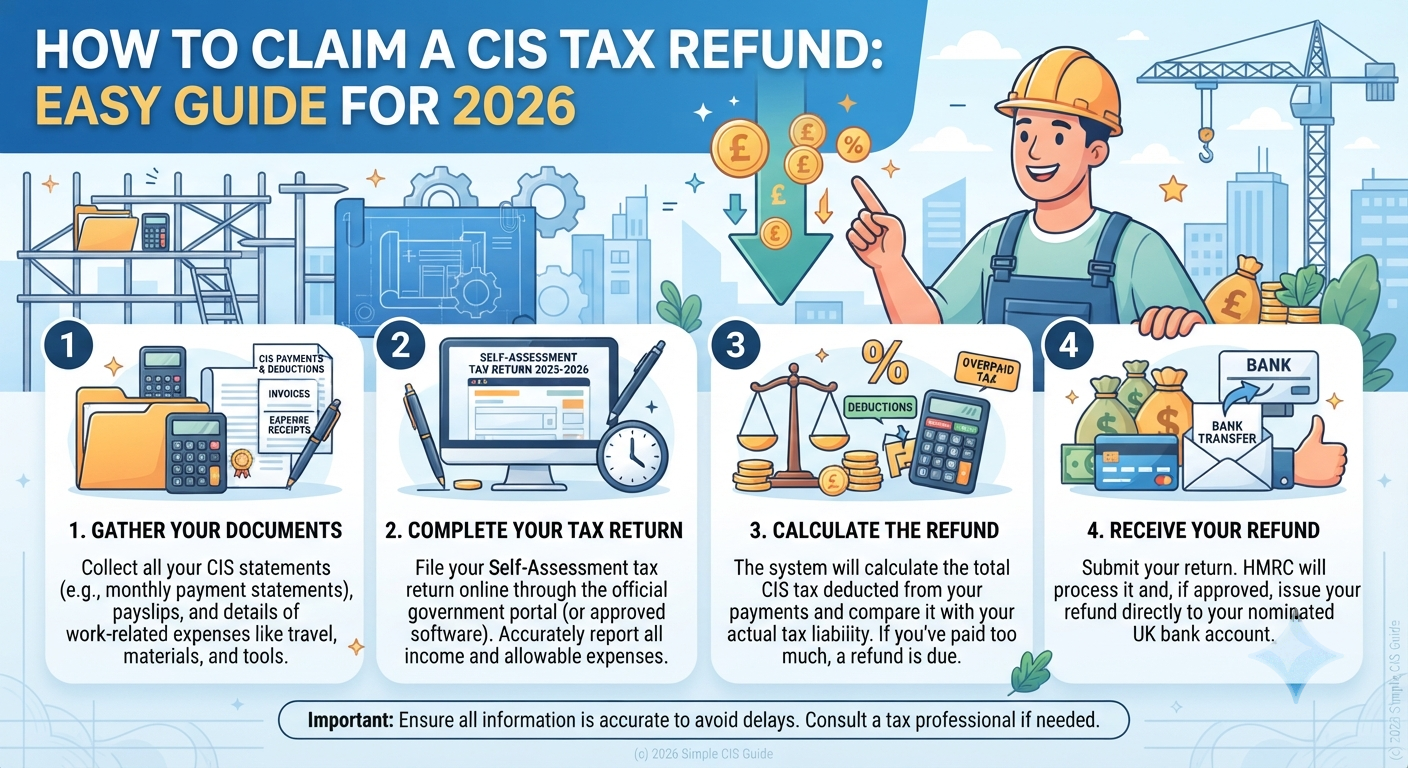
How to Claim a CIS Tax Refund
If you work in the UK construction industry as a subcontractor, you may have CIS tax deducted from your payments before you receive your money. For many subcontractors, these deductions are simply advance payments towards their tax and National Insurance bill.
But what happens if you have paid more CIS tax than you actually owe?
You may be entitled to a CIS tax refund.
The good news is that claiming a CIS refund does not necessarily mean starting a complicated process. If you are a sole trader or partner, your CIS deductions are normally included in your Self Assessment tax return. HMRC then works out how much tax you owe and credits the CIS deductions against it. If your deductions are greater than your final liability, you may be due a repayment.
This guide explains how to claim a CIS tax refund in 2026, who can claim, how much you might get back, what records you need and what to do if you have been taxed at the wrong CIS rate.
Quick Summary
A CIS tax refund may be available when the CIS deductions taken from your construction payments are greater than the tax and National Insurance you ultimately owe.
For a sole trader or partner:
- CIS deductions are treated as advance payments towards your tax and National Insurance.
- You report your total income and CIS deductions on your Self Assessment tax return.
- HMRC calculates your final tax liability.
- CIS deductions are credited against the amount you owe.
- If the deductions are greater than your liability, HMRC can repay the difference.
- You should keep your contractor payment and deduction statements as evidence.
If you are a limited company, the process is different because CIS deductions are normally used against PAYE and other company liabilities before any remaining amount is refunded.
What Is a CIS Tax Refund?
A CIS tax refund is money returned to you when the CIS deductions taken from your construction payments are more than the tax and National Insurance liabilities they need to cover.
Under the Construction Industry Scheme, contractors usually deduct 20% from payments to registered subcontractors. If a subcontractor is not registered or cannot be verified, the deduction can be 30%. Subcontractors with gross payment status generally have no CIS deductions taken from their payments.
These deductions are not normally an extra tax on top of your final tax bill. They are advance payments towards your tax and National Insurance liability.
For example, imagine you receive:
- Construction income: £40,000
- CIS deducted by contractors: £8,000
- Final tax and National Insurance liability: £5,500
The £8,000 already deducted is credited against your liability. If £5,500 is due, there could be £2,500 remaining to repay, subject to your overall tax position.
Who Can Claim a CIS Tax Refund?
CIS refunds can apply to different types of subcontractors, but the process depends on your business structure.
You may be affected by CIS if you work as:
- A sole trader
- A partner in a partnership
- The owner of a limited company working as a subcontractor
HMRC has different procedures for individuals and limited companies.
Sole Traders and Partners
If you are a sole trader or partner, you normally claim your CIS deductions through your Self Assessment tax return.
You report:
- Your total income before CIS deductions.
- Your allowable business expenses.
- The CIS deductions taken by contractors.
HMRC then calculates your tax position and credits the CIS deductions against the amount you owe. If you have paid too much, you may receive a refund.
Limited Companies
Limited companies follow a different process.
CIS deductions are normally credited against liabilities such as PAYE, National Insurance and other relevant amounts. If deductions remain after the company’s liabilities have been dealt with, the company may be able to claim a refund.
You should not simply claim CIS deductions through the Corporation Tax return as if they were ordinary Corporation Tax payments. HMRC has a specific process for CIS deductions suffered by companies.
How Much CIS Tax Can You Claim Back?
There is no single fixed CIS tax refund amount.
The amount you can receive depends on:
- Your total construction income
- Your CIS deductions
- Your allowable business expenses
- Your final taxable profit
- Income from other sources
- Income Tax due
- National Insurance liabilities
- Any tax already paid
- Any outstanding HMRC liabilities
In simple terms:
CIS deductions − final liabilities = potential repayment
However, this is only a simplified explanation. HMRC considers your overall tax position rather than automatically refunding every CIS deduction.
Example of a CIS Refund
Suppose a subcontractor earns £50,000 during the tax year.
Their contractors deduct:
20% CIS = £10,000
The subcontractor also has £15,000 of allowable business expenses.
Their taxable profit is therefore broadly:
£50,000 − £15,000 = £35,000
After taking account of their tax-free allowance, Income Tax and National Insurance, suppose their final liability is £6,500.
The £10,000 CIS deduction is credited against this liability.
That could leave:
£10,000 − £6,500 = £3,500
So the subcontractor may be due a refund of around £3,500, assuming there are no other liabilities or adjustments affecting the calculation.
This is only an illustration. Your actual refund will depend on your complete tax return.
How to Claim a CIS Tax Refund Through Self Assessment
If you are a sole trader or partner, the normal process is straightforward.
1. Collect Your CIS Payment and Deduction Statements
Your contractor should give you a payment and deduction statement showing how much they paid you and how much CIS they deducted.
Contractors normally need to provide these statements within 14 days of the end of the relevant tax month.
Keep these statements carefully because HMRC may ask you to provide evidence of your deductions.
If you lose a statement, ask the contractor for a replacement.
2. Add Up Your CIS Deductions
Go through your statements and calculate the total CIS deductions for the tax year.
Make sure you do not:
- Count the same deduction twice
- Include amounts that were not actually deducted
- Guess missing figures
- Claim CIS deductions that were never taken
HMRC guidance makes clear that a subcontractor can only receive credit for CIS deductions that were actually made.
3. Complete Your Self Assessment Tax Return
When completing your Self Assessment tax return, report your business income and relevant CIS deductions.
Your income should generally be reported before the CIS deduction was taken.
For example:
Contractor payment: £5,000
CIS deducted: £1,000
Amount received: £4,000
Your income is £5,000, while the £1,000 CIS deduction is recorded separately.
HMRC then uses the CIS deduction as a credit against your tax liability.
4. Include Your Allowable Business Expenses
Your final tax liability depends on your taxable profit, so it is important to claim legitimate allowable business expenses.
Depending on your circumstances, these could include costs such as:
- Tools and equipment
- Protective clothing
- Work-related travel
- Vehicle expenses
- Insurance
- Professional fees
- Business software
- Telephone and internet costs
- Office expenses
- Other genuine business costs
You should only claim expenses that meet HMRC’s rules.
5. Let HMRC Calculate Your Final Position
Once your return has been submitted, HMRC works out how much tax and National Insurance you owe.
Your CIS deductions are then taken into account.
If you have paid more than you owe, HMRC can repay the excess.
If you still owe tax after the CIS credit has been applied, you will need to pay the remaining amount.
Can You Claim a CIS Refund Before the End of the Tax Year?
In certain circumstances, yes.
HMRC allows eligible self-employed subcontractors to make an in-year repayment claim rather than always waiting until the end of the tax year.
The CIS40 process can be used by individuals to claim repayment of CIS deductions during the current tax year. After the tax year has ended, you normally use your Self Assessment tax return instead.
This can be useful if you have stopped trading or your circumstances mean you are unlikely to use all of the CIS deductions against your final tax liability.
However, HMRC may check your tax position and outstanding returns before making a repayment.
What If You Stop Working as a Subcontractor?
If you stop trading during the tax year, you may be able to claim a refund of CIS deductions already paid during that tax year.
HMRC specifically provides an in-year repayment process for eligible sole traders and partners who have stopped trading.
You should make sure your tax records are up to date before making the claim.
What If You Were Deducted 30% CIS?
If you were deducted at 30%, it does not automatically mean you are entitled to a 30% refund.
The 30% rate generally applies where a subcontractor is not registered for CIS or cannot be verified.
For registered and verified subcontractors, the standard deduction rate is 20%.
The CIS deduction is an advance payment towards your final tax and National Insurance liability. Your eventual refund depends on your complete tax position.
Example
You receive £30,000 of payments subject to CIS.
At 30%, your contractor deducts:
£30,000 × 30% = £9,000
You receive £21,000.
The £9,000 is treated as CIS tax paid towards your liability.
If your final tax and National Insurance liability is £6,000, you could potentially have £3,000 left over, subject to your complete tax position.
What If Your Contractor Deducted the Wrong Amount?
If you believe your contractor has deducted the wrong amount, check your payment and deduction statement first.
Compare:
- Gross payment
- Materials
- VAT, if applicable
- CIS deduction
- Amount actually received
If the figures are wrong, speak to the contractor and ask them to correct the issue.
You should not simply claim a CIS credit for an amount that was supposed to be deducted but was never actually deducted. HMRC guidance states that credit is only available for CIS deductions actually made.
What Records Do You Need for a CIS Refund?
Good record keeping is important when claiming a CIS refund.
Keep:
- CIS payment and deduction statements
- Contractor invoices
- Sales records
- Business bank statements
- Expense receipts
- Purchase invoices
- Mileage records
- Vehicle records
- Equipment receipts
- Tax return records
- Evidence of other business income
Your contractor statements should clearly show the CIS deductions.
If HMRC questions your claim, you may need to provide evidence supporting the deductions.
Can CIS Deductions Be Used Against Other Tax Debts?
Yes, depending on your circumstances.
CIS deductions are treated as advance payments towards relevant tax and National Insurance liabilities.
This means you may not necessarily receive the full amount of your CIS deductions as cash.
For example, suppose:
- CIS deductions: £8,000
- Tax liability: £6,000
- Other relevant outstanding liability: £1,000
There may only be £1,000 left available for repayment.
For limited companies, HMRC can use CIS deductions against certain PAYE and other liabilities before paying any remaining amount as a refund.
CIS Refund vs CIS Deduction
These two terms are often confused.
CIS Deduction
A CIS deduction is the amount your contractor takes from your payment and pays to HMRC on your behalf.
CIS Refund
A CIS refund is money returned when the amount credited from your CIS deductions is greater than the liabilities it needs to cover.
For example:
Invoice: £5,000
CIS deduction: £1,000
Amount received: £4,000
The £1,000 is a CIS deduction.
If your final tax liability is lower than the CIS amount available after all relevant calculations, the difference may become a refund.
Does Having CIS Tax Deducted Mean You Have Paid Too Much Tax?
Not necessarily.
CIS deductions are advance payments towards your tax and National Insurance bill.
If you have £10,000 deducted, it does not automatically mean you will get £10,000 back.
For example:
CIS deducted: £10,000
Final tax and National Insurance liability: £10,000
In this situation, there may be no CIS refund because the deduction has covered the liability.
A refund generally arises when the credit exceeds the liabilities that need to be covered.
Can Business Expenses Increase Your CIS Refund?
Potentially, yes.
Allowable business expenses reduce your taxable profit.
If your taxable profit is lower, your final tax liability may also be lower. Because CIS deductions are already credited against that liability, a lower liability can result in a larger repayment.
For example:
Construction income: £45,000
CIS deducted: £9,000
Allowable expenses: £12,000
Your taxable profit is broadly £33,000 before other tax adjustments.
The lower taxable profit may reduce your final tax bill compared with a situation where you claimed no allowable expenses.
However, expenses must be genuine, allowable and properly supported by records.
You should never claim personal expenses simply to increase a CIS refund.
What Happens If You Have More Than One Contractor?
It is common for construction subcontractors to work for multiple contractors.
Each contractor may provide a separate payment and deduction statement.
You should collect all statements and make sure your Self Assessment return includes the total CIS deductions for the relevant tax year.
For example:
| Contractor | CIS Deducted |
|---|---|
| Contractor A | £2,000 |
| Contractor B | £1,500 |
| Contractor C | £2,500 |
| Total | £6,000 |
Your return should reflect the relevant total rather than just the statement from one contractor.
What If You Cannot Get Your CIS Statement?
If you cannot obtain a payment and deduction statement from your contractor, first ask the contractor for a replacement.
If you still cannot get the information, HMRC provides a process for contacting them with details such as:
- Your name and address
- UTR
- Contractor’s name and address
- Contractor’s tax reference, if known
- Payment dates or tax months
- Relevant payment information
- Reason you do not have the statement
HMRC may then investigate the information.
Can Limited Companies Claim a CIS Tax Refund?
Yes, but the process is different from that for sole traders.
A limited company subcontractor generally uses its payroll scheme to account for CIS deductions.
The company submits its normal Full Payment Submission and Employer Payment Summary and reports the CIS deductions.
HMRC uses the deductions against relevant liabilities. If deductions remain after those liabilities have been dealt with, the company may claim a refund.
A company can generally claim for a completed tax year, and HMRC says claims can be made for the past six tax years online or by post.
When Should You Claim Your CIS Refund?
For most sole traders and partners, the normal route is to claim through your Self Assessment tax return after the end of the tax year.
If you are eligible for an in-year repayment, you may be able to claim before the tax year ends using the relevant HMRC process.
The best option depends on your circumstances.
If you are still trading normally, waiting for your Self Assessment return may be the simplest route.
If you have stopped trading and need an in-year repayment, check HMRC’s CIS repayment rules.
Common CIS Tax Refund Mistakes
Many refund problems come from simple bookkeeping errors.
Claiming CIS Deductions That Were Not Actually Taken
Only claim deductions that were actually made.
Forgetting a Contractor
If you worked for several contractors, make sure you collect every payment and deduction statement.
Entering Net Income Instead of Gross Income
Your business income should generally be recorded before CIS deductions.
Double-Counting CIS
Do not enter the same CIS deduction twice.
Losing Payment and Deduction Statements
Keep statements organised throughout the tax year.
Claiming Personal Expenses
Personal spending should not be claimed as a business expense simply because you are trying to reduce your tax bill.
Ignoring Other Income
Your final tax position may include income from other sources, which can affect the refund.
Assuming All CIS Deductions Will Be Refunded
CIS deductions are credits against your tax and National Insurance liabilities, not guaranteed refunds.
How to Make Your CIS Tax Refund Easier
A simple bookkeeping system can prevent many CIS problems.
Each month:
- Save every contractor statement.
- Record the gross payment.
- Record the CIS deduction.
- Record the amount actually received.
- Record allowable expenses.
- Reconcile your bank account.
- Check that contractor records match your bookkeeping.
At the end of the tax year, you should already have most of the information needed for your Self Assessment return.
CIS Tax Refund Checklist for 2026
Before submitting your claim or tax return, check:
- All contractor statements are available
- Total CIS deductions have been calculated
- Gross income has been recorded correctly
- Allowable expenses have been recorded
- Business bank transactions have been reconciled
- No CIS deduction has been entered twice
- Other taxable income has been considered
- Your UTR details are correct
- Your Self Assessment return is complete
- You have retained supporting records
Frequently Asked Questions
How much CIS tax can I claim back?
There is no fixed CIS refund amount. Your refund depends on your total CIS deductions compared with your final Income Tax, National Insurance and other relevant liabilities.
Do I get all my CIS deductions back?
No. CIS deductions are advance payments towards your tax and National Insurance. You only receive a refund of any amount left after your relevant liabilities have been accounted for.
How do I claim a CIS refund as a sole trader?
A sole trader normally reports their gross income and CIS deductions on their Self Assessment tax return. HMRC then calculates the final liability and any repayment due.
Can I claim a CIS refund during the tax year?
In certain circumstances, eligible self-employed subcontractors can make an in-year repayment claim using the CIS repayment process.
What percentage is CIS tax?
The standard CIS deduction is generally 20% for registered and verified subcontractors. The higher rate is 30% where the subcontractor is not registered or cannot be verified. Gross payment status can mean no CIS deduction is taken.
What happens if I was deducted 30% CIS?
The 30% deduction is treated as an advance payment towards your tax and National Insurance. You do not automatically receive the extra 10% back. Your final refund depends on your overall tax position.
Do I need CIS deduction statements?
Yes. Keep your contractor payment and deduction statements as evidence of the CIS deductions taken from your payments.
Can I claim a CIS refund if I have stopped trading?
You may be able to make an in-year repayment claim for CIS deductions already paid during the tax year, subject to HMRC’s requirements.
Can a limited company claim a CIS refund?
Yes. A limited company can use CIS deductions against relevant liabilities and may claim a refund when deductions remain after those liabilities have been dealt with.
Can I claim CIS deductions if my contractor did not actually deduct them?
No. HMRC guidance states that credit is available for CIS deductions actually made, not amounts that should have been deducted but were not.
Final Thoughts
A CIS tax refund can be valuable for construction subcontractors who have had more tax deducted than they ultimately owe.
The key is to keep accurate records of your gross income, CIS deductions and allowable business expenses.
For most sole traders and partners, the CIS refund is dealt with through Self Assessment. HMRC compares your CIS deductions with your final tax and National Insurance position and refunds any amount that remains due.
If you are claiming during the tax year, have stopped trading, or operate through a limited company, the repayment process can be different.
The safest approach is to keep every CIS statement, reconcile your records regularly and make sure your tax return accurately reflects the amounts actually deducted.
For complex situations, getting professional tax advice can help you avoid delays, incorrect claims and unexpected tax bills.