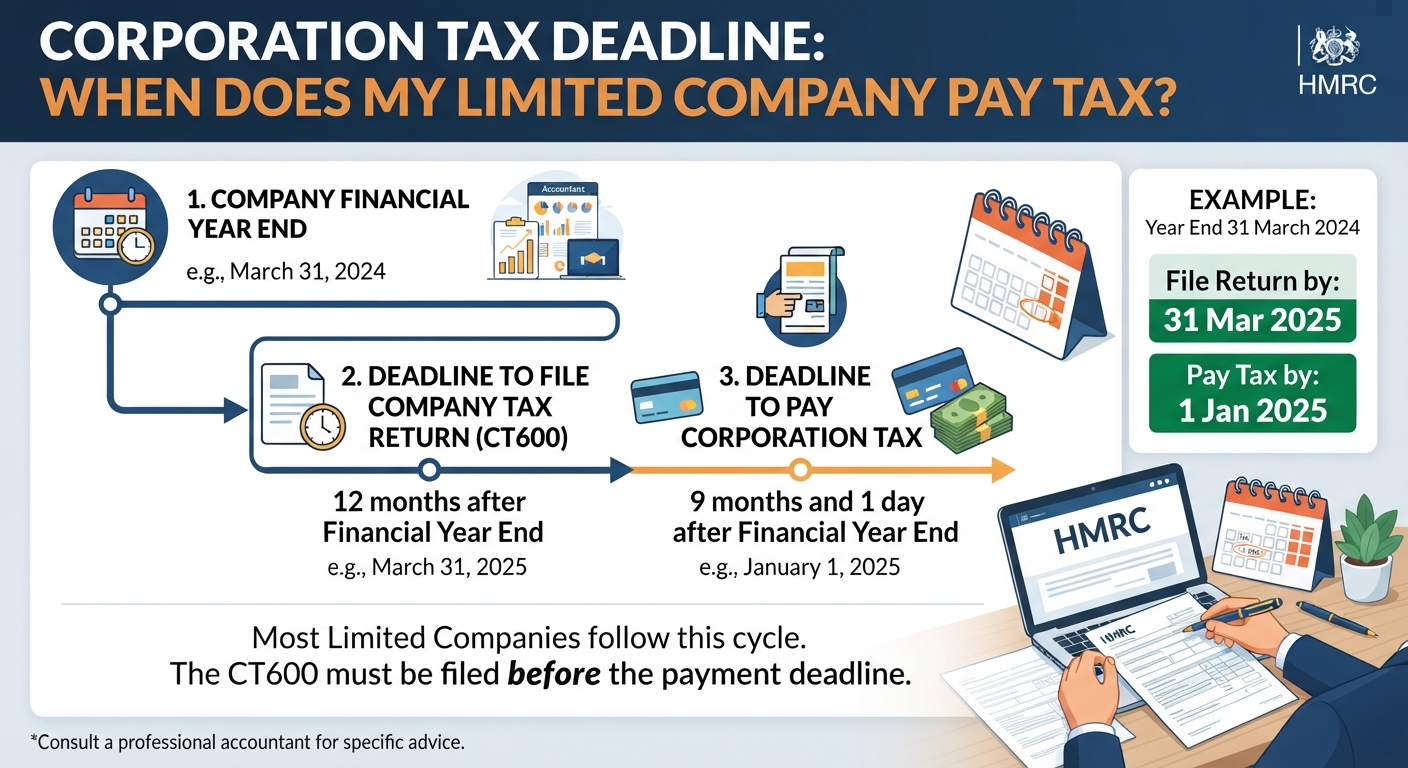
Corporation Tax Deadline: When Does My Company Pay?
Quick Summary
If you run a UK limited company, you need to know when Corporation Tax is due, when your Company Tax Return must be filed, and how your accounting period affects both deadlines.
For most companies with taxable profits of up to £1.5 million, Corporation Tax is normally due 9 months and 1 day after the end of the company’s accounting period. The Company Tax Return is normally due 12 months after the end of that accounting period.
This means your Corporation Tax payment deadline normally comes before your tax return filing deadline.
For example, if your accounting period ends on 31 December 2026, your Corporation Tax will normally be due on 1 October 2027, while your Company Tax Return will normally be due on 31 December 2027.
Understanding these dates can help you avoid late-payment interest, penalties and unnecessary cash-flow pressure.
Key Takeaways
- Most limited companies pay Corporation Tax 9 months and 1 day after their accounting period ends.
- Your Company Tax Return is normally due 12 months after the accounting period ends.
- Your tax payment deadline and tax return deadline are not the same date.
- Your accounting period can be different from your company’s financial year, particularly when the company is newly incorporated or changes its accounting date.
- Companies with taxable profits above £1.5 million may have to pay Corporation Tax in instalments.
- You still normally need to file a Company Tax Return even if your company makes a loss or has no Corporation Tax to pay.
- Late Corporation Tax payments can result in interest.
- Late Company Tax Returns can result in penalties.
- Good bookkeeping throughout the year makes Corporation Tax planning much easier.
Quick Answer: When Does a Limited Company Pay Corporation Tax?
For most UK limited companies, Corporation Tax is due 9 months and 1 day after the end of the accounting period.
Your Company Tax Return is normally due 12 months after the end of the accounting period.
Simple Example
Suppose your company has an accounting period ending:
31 December 2026
Your normal deadlines would be:
| Requirement | Deadline |
|---|---|
| Corporation Tax payment | 1 October 2027 |
| Company Tax Return | 31 December 2027 |
So you could have almost three months between the Corporation Tax payment deadline and the tax return filing deadline.
Important: Do not assume that because your tax return is not due yet, your Corporation Tax payment is also not due.
Who Is This Guide For?
This guide is designed for:
- UK limited company directors
- Small business owners
- First-time company directors
- Contractors operating through limited companies
- Freelancers using a limited company
- Startups
- Small companies preparing for their first Corporation Tax payment
- Directors who are unsure about their HMRC deadlines
- Business owners who want to avoid late tax payments
If you have recently incorporated a limited company, understanding your first accounting period and Corporation Tax deadline is particularly important.
Introduction
Running a limited company comes with several important tax deadlines.
One of the biggest is Corporation Tax.
Many directors understand that their company has to pay Corporation Tax on taxable profits, but they are less certain about when the payment actually needs to reach HMRC.
A common mistake is assuming that the Corporation Tax deadline is the same as the Company Tax Return deadline.
It is not.
For most companies, Corporation Tax must be paid 9 months and 1 day after the end of the accounting period, while the Company Tax Return is normally filed 12 months after the end of the accounting period.
This guide explains the deadlines in simple terms and gives you practical examples so you can work out when your limited company needs to pay Corporation Tax.
1. What Is Corporation Tax?
Corporation Tax is a tax charged on the taxable profits of companies.
A limited company calculates its taxable profit and uses that figure to determine its Corporation Tax liability.
The taxable profit used for Corporation Tax purposes can be different from the accounting profit shown in your company’s accounts.
HMRC explains that when preparing a Company Tax Return, a company works out its profit or loss for Corporation Tax and its Corporation Tax bill.
This is why simply looking at your bank balance or your accounting software’s profit figure is not always enough to determine your final Corporation Tax liability.
2. When Is Corporation Tax Due?
For most limited companies, Corporation Tax is due:
9 months and 1 day after the end of the accounting period.
This is the standard payment deadline for companies with taxable profits of up to £1.5 million.
Example
If your accounting period ends on:
31 March 2026
your Corporation Tax payment deadline would normally be:
1 January 2027
If your accounting period ends on:
30 June 2026
your Corporation Tax payment deadline would normally be:
1 April 2027
The exact date depends on your company’s accounting period end date.
3. What Is an Accounting Period?
Your Corporation Tax accounting period is the period covered by your Company Tax Return.
HMRC states that a Corporation Tax accounting period cannot be longer than 12 months. It is normally the same as the financial year covered by the company’s annual accounts, although there can be differences, particularly during the first year of the company.
This distinction is important because your Corporation Tax deadline is calculated from the accounting period, not simply from the date you registered your company.
In Simple Terms
Accounting period ends → add 9 months and 1 day → Corporation Tax payment deadline
4. Corporation Tax Payment Deadline vs Tax Return Deadline
This is one of the most important things for directors to understand.
There are two separate deadlines.
Corporation Tax Payment
Normally:
9 months and 1 day after the accounting period ends
Company Tax Return
Normally:
12 months after the accounting period ends
HMRC confirms that the Company Tax Return deadline is 12 months after the end of the accounting period.
Example
Imagine your company has an accounting period ending on:
31 December 2026
Your deadlines would normally be:
| Task | Deadline |
|---|---|
| Corporation Tax payment | 1 October 2027 |
| Company Tax Return | 31 December 2027 |
This means you generally need to have the tax payment ready before your tax return filing deadline.
5. Why Is the Corporation Tax Payment Due Before the Tax Return?
This can seem confusing.
You might think:
“If my tax return is not due until December, why do I have to pay tax in October?”
The reason is that the UK Corporation Tax system has separate payment and filing deadlines.
HMRC specifically states that the Corporation Tax payment deadline comes before the Company Tax Return filing deadline for most companies.
This means directors should not wait until the tax return deadline to think about Corporation Tax.
Instead, you should estimate your company’s tax liability well before the payment deadline.
6. How to Calculate Your Corporation Tax Deadline
You can use a simple process.
Step 1: Find Your Accounting Period End Date
Check your company’s accounting information or HMRC business tax account.
Step 2: Identify the Final Day of the Accounting Period
For example:
31 March 2026
Step 3: Add 9 Months
31 March 2026 + 9 months = 31 December 2026
Step 4: Add 1 Day
Your Corporation Tax payment deadline becomes:
1 January 2027
This is the standard rule for most companies.
7. Corporation Tax Deadline Examples for 2026
Here are some examples to make the rule easier to understand.
| Accounting period ends | Corporation Tax normally due |
|---|---|
| 31 January 2026 | 1 November 2026 |
| 28 February 2026 | 1 December 2026 |
| 31 March 2026 | 1 January 2027 |
| 30 April 2026 | 1 February 2027 |
| 31 May 2026 | 1 March 2027 |
| 30 June 2026 | 1 April 2027 |
| 31 July 2026 | 1 May 2027 |
| 31 August 2026 | 1 June 2027 |
| 30 September 2026 | 1 July 2027 |
| 31 October 2026 | 1 August 2027 |
| 30 November 2026 | 1 September 2027 |
| 31 December 2026 | 1 October 2027 |
These examples follow HMRC’s general rule of nine months and one day after the accounting period ends.
8. When Is the Company Tax Return Due?
Your Company Tax Return is normally due:
12 months after the end of the accounting period.
For example:
Accounting period ends: 31 December 2026
Company Tax Return deadline: 31 December 2027
Remember:
Tax payment deadline ≠ tax return deadline
You normally pay first and file the return later.
9. Do You Still Need to File a Tax Return If Your Company Made a Loss?
Yes.
A company can still have a Company Tax Return filing obligation even if it has made a loss or has no Corporation Tax to pay.
HMRC states that companies must still send a Company Tax Return if they make a loss or have no Corporation Tax to pay, where they have received a notice to deliver a return.
So don’t assume:
“My company made no profit, so I don’t need to file anything.”
That can be a costly mistake.
10. What Happens If Your Company Makes No Profit?
If your company has no taxable profit, it may have no Corporation Tax to pay.
However, you may still need to file the relevant Company Tax Return with HMRC.
You should also make sure your company records clearly show why there is no Corporation Tax liability.
Good bookkeeping is particularly useful here because you need accurate records to establish your company’s financial position.
11. What Happens If You Pay Corporation Tax Late?
If you miss your Corporation Tax payment deadline, HMRC can charge interest on late payments.
This is one reason it is important to plan for Corporation Tax before the deadline arrives.
A company can be profitable on paper but still have insufficient cash in its bank account if the director has withdrawn too much money or the business has large unpaid invoices.
Example
Your company calculates that it owes:
£12,000 Corporation Tax
But the business bank account contains only:
£7,000
You have a potential:
£5,000 cash-flow shortfall
The tax deadline does not move simply because the company does not currently have enough cash.
12. How Can Directors Prepare for the Corporation Tax Bill?
A simple approach is to put money aside throughout the year.
For example, if you expect a Corporation Tax bill of around £12,000, you could consider setting aside approximately:
£1,000 per month
over 12 months.
This is only a budgeting example, not a calculation of your actual Corporation Tax liability.
Your final liability depends on your company’s taxable profits, allowable deductions, tax rate and other relevant adjustments.
13. Should You Put Money Aside for Corporation Tax?
For many small companies, yes.
Creating a separate savings account or simply maintaining a dedicated Corporation Tax reserve can make the payment easier to manage.
A Simple System
- Record income correctly.
- Record business expenses.
- Reconcile your bank account.
- Review your profit regularly.
- Estimate Corporation Tax.
- Set aside money for the expected bill.
- Recalculate before the deadline.
- Pay HMRC on time.
This is much safer than waiting until the last week.
14. What Is the Corporation Tax Deadline for a New Limited Company?
New companies can be more complicated because the first accounting period and first Corporation Tax accounting period may not line up exactly with the company’s first financial year.
HMRC explains that a company’s Corporation Tax accounting period can be different in the year it is set up.
This is why new directors should check their actual accounting period rather than assuming the deadline based only on the incorporation date.
Example
You incorporate your company in:
May 2026
Your first accounting period may not simply run from May 2026 to May 2027 for Corporation Tax purposes.
You should check the dates HMRC has recorded for your company.
15. What Happens If Your Accounts Cover More Than 12 Months?
A Corporation Tax accounting period cannot be longer than 12 months.
If your company’s accounts cover more than 12 months, you may need more than one Corporation Tax accounting period and therefore more than one Company Tax Return.
This is particularly important when changing your company’s accounting year end.
Example
Suppose your company’s accounts are extended from:
31 December
to:
31 March
The accounts may cover more than 12 months.
That does not mean you can simply use one Corporation Tax accounting period covering the whole period.
HMRC requires the Corporation Tax accounting periods to be dealt with separately.
16. What If Your Accounting Period Is Less Than 12 Months?
Your accounting period can also be shorter than 12 months.
This can happen when a company:
- Changes its accounting date
- Closes down
- Restarts trading
- Has another change affecting its accounting period
HMRC confirms that an accounting period can be shorter than 12 months.
Your payment deadline will then be calculated based on the relevant accounting period.
17. What About Companies With Large Profits?
The standard 9-month-and-1-day payment rule does not apply in the same way to all companies.
Companies with taxable profits above certain thresholds may have to pay Corporation Tax in instalments.
HMRC currently states that companies with taxable profits of more than £1.5 million generally pay Corporation Tax in instalments, subject to the detailed rules and exceptions.
For a typical small limited company, however, the standard 9 months and 1 day rule is the key deadline to remember.
18. How Do Large Companies Pay Corporation Tax?
Large companies generally pay Corporation Tax in quarterly instalments.
For a 12-month accounting period, HMRC’s instalment rules can require four payments, with some payments occurring before the accounting period has ended.
The calculation can become more complicated when there are:
- Associated companies
- Short accounting periods
- Changes in expected taxable profits
- Tax liabilities above certain thresholds
If your company is approaching the large-company thresholds, professional tax advice is recommended.
19. Corporation Tax Deadline vs Companies House Deadline
Another common mistake is confusing HMRC deadlines with Companies House deadlines.
They are separate.
For a private limited company, annual accounts are generally due at Companies House 9 months after the company’s financial year ends.
Corporation Tax is normally due to HMRC 9 months and 1 day after the Corporation Tax accounting period ends.
The Company Tax Return is normally due 12 months after the Corporation Tax accounting period ends.
Simple Comparison
| Requirement | Typical deadline |
|---|---|
| Annual accounts to Companies House | 9 months after financial year end |
| Corporation Tax payment | 9 months + 1 day after accounting period end |
| Company Tax Return | 12 months after accounting period end |
These dates can be different depending on your company’s circumstances.
20. Why Good Bookkeeping Matters Before Corporation Tax Is Due
Your Corporation Tax calculation is only as reliable as your financial records.
Poor bookkeeping can result in:
- Missing expenses
- Incorrect income figures
- Duplicate transactions
- Incorrect VAT treatment
- Unreconciled bank accounts
- Incorrect profit calculations
- Cash-flow surprises
- Last-minute tax work
Regular bookkeeping allows you to see your estimated taxable position before the deadline.
21. What Records Should a Limited Company Keep?
A company should maintain accurate financial records to support its accounts and tax calculations.
Useful records include:
- Sales invoices
- Purchase invoices
- Business receipts
- Bank statements
- Expense records
- Payroll records
- VAT records where applicable
- Asset purchases
- Loan records
- Director expense claims
- Accounting adjustments
- Tax records
The better your records, the easier it is to prepare your accounts and Corporation Tax return.
22. Can Accounting Software Help With Corporation Tax Planning?
Yes.
Accounting software can help you keep track of:
- Sales
- Expenses
- Bank transactions
- Invoices
- Bills
- Profit and loss
- VAT
- Payroll
- Financial reports
However, accounting software does not automatically mean your Corporation Tax calculation is correct.
You still need to make sure transactions are recorded correctly and that relevant tax adjustments are considered.
23. What Should You Do Before Your Corporation Tax Deadline?
Use this simple checklist.
Corporation Tax Checklist
☐ Confirm your accounting period end date
☐ Check your Corporation Tax payment deadline
☐ Reconcile your business bank account
☐ Make sure all sales are recorded
☐ Record all legitimate business expenses
☐ Review outstanding invoices
☐ Review company assets
☐ Check director expenses
☐ Review loans and finance
☐ Calculate estimated taxable profit
☐ Estimate your Corporation Tax liability
☐ Set aside enough cash
☐ Prepare your Company Tax Return
☐ Pay Corporation Tax before the deadline
☐ Keep evidence of the payment
This checklist can help reduce last-minute problems.
24. What Happens If You Cannot Afford Your Corporation Tax Bill?
If your company may not have enough money to pay its Corporation Tax bill, do not simply ignore the deadline.
You should review the company’s cash flow as early as possible and seek professional advice where necessary.
HMRC can charge interest when Corporation Tax is paid late.
The earlier you identify a potential shortfall, the more options you may have to manage the situation.
25. Common Corporation Tax Deadline Mistakes
Mistake 1: Waiting for the Tax Return Deadline
Your Corporation Tax payment is normally due before your Company Tax Return.
Mistake 2: Using the Incorporation Date
Your Corporation Tax deadline is based on the relevant accounting period, not simply your incorporation date.
Mistake 3: Confusing Companies House and HMRC
Companies House accounts and HMRC Corporation Tax obligations have separate deadlines.
Mistake 4: Spending the Corporation Tax Money
The cash in your business bank account is not necessarily all available for personal drawings or business spending.
Mistake 5: Ignoring Small Expenses
Accurate bookkeeping helps ensure your taxable profit calculation is based on complete records.
Mistake 6: Leaving Everything Until the Deadline
Last-minute bookkeeping increases the risk of errors and cash-flow problems.
Mistake 7: Assuming No Profit Means No Filing
A company can still have a Company Tax Return obligation even if it makes a loss or has no Corporation Tax to pay.
26. A Simple Corporation Tax Example
Let’s say:
Company: ABC Consulting Ltd
Accounting period: 1 January 2026 to 31 December 2026
Estimated taxable profit: £50,000
The company reviews its taxable profit and calculates its Corporation Tax liability.
The accounting period ends:
31 December 2026
The normal Corporation Tax payment deadline would be:
1 October 2027
The Company Tax Return deadline would normally be:
31 December 2027
The director should therefore have the Corporation Tax money available before October 2027 rather than waiting until December.
27. Another Example: Why Cash Flow Matters
Imagine a company has:
Annual sales: £150,000
Business costs: £90,000
This leaves an accounting profit of approximately:
£60,000
But the company may have other tax adjustments that affect taxable profit.
At the same time, the director may have withdrawn money from the company during the year.
The company could therefore appear profitable but have less cash available than expected.
This is why Corporation Tax planning should be part of regular financial management rather than something done once a year.
28. Can You Pay Corporation Tax Early?
Yes.
HMRC allows companies to make Corporation Tax payments before the deadline, and HMRC states that interest may be paid when tax is paid early.
For a small company, paying early may not always be necessary, but having the money ready before the deadline can provide peace of mind.
29. How Should You Plan for Your Corporation Tax Bill?
A practical approach is:
Monthly
Review:
- Revenue
- Expenses
- Profit
- Bank balance
- Outstanding invoices
Quarterly
Review:
- Estimated taxable profit
- Corporation Tax provision
- Cash reserves
- Director drawings
- Major purchases
Before Year End
Review:
- Expenses
- Assets
- Payroll
- Director transactions
- Outstanding invoices
- Tax adjustments
Before the Deadline
Confirm:
- Final Corporation Tax liability
- Payment reference
- Payment date
- Available cash
- Company Tax Return status
30. What Is the Corporation Tax Payment Reference?
When paying Corporation Tax, you need to use the correct payment reference for the relevant accounting period.
HMRC provides payment instructions and explains how to pay Corporation Tax electronically.
Always check the payment reference carefully before making the transfer.
A payment going to HMRC is not enough by itself if the payment is not correctly allocated to the relevant liability.
31. How Long Does an HMRC Corporation Tax Payment Take?
The time required for your payment to reach HMRC depends on the payment method.
HMRC currently lists different processing times for methods including Faster Payments, CHAPS, Bacs and Direct Debit.
For this reason, don’t leave the payment until the final few hours.
If your deadline is approaching, allow sufficient time for the payment to reach HMRC.
32. What If the Deadline Falls on a Weekend or Bank Holiday?
If your payment deadline falls on a weekend or bank holiday, you should make sure HMRC receives the payment on time.
HMRC advises companies to make the payment by the last working day before the deadline, subject to the payment method being used.
This is another reason to avoid leaving Corporation Tax payments until the last minute.
33. When Should a Director Speak to an Accountant?
You may want professional help if:
- This is your first Corporation Tax return
- Your company has complicated transactions
- You have associated companies
- Your profits are increasing significantly
- Your company has large asset purchases
- You have director loans
- You have international transactions
- You are changing your accounting year end
- You are unsure about taxable profit
- You have missed a tax deadline
- Your company cannot afford its tax bill
An accountant can help you understand the company’s tax position and plan for upcoming deadlines.
34. 2026 Corporation Tax Deadline Checklist
Before the Corporation Tax deadline, ask yourself:
Accounting
☐ Is bookkeeping up to date?
☐ Are all bank transactions reconciled?
☐ Are all sales recorded?
☐ Are business expenses recorded?
Tax
☐ What is the company’s accounting period?
☐ What is the Corporation Tax payment deadline?
☐ What is the estimated taxable profit?
☐ How much Corporation Tax is expected?
Cash Flow
☐ Is enough money reserved for Corporation Tax?
☐ Are major upcoming expenses accounted for?
☐ Have director withdrawals been reviewed?
Filing
☐ Is the Company Tax Return prepared?
☐ Is the correct payment reference being used?
☐ Will the payment reach HMRC before the deadline?
Frequently Asked Questions
When Does a Limited Company Pay Corporation Tax?
Most limited companies with taxable profits of up to £1.5 million normally pay Corporation Tax 9 months and 1 day after the end of their accounting period.
When Is a Company Tax Return Due?
A Company Tax Return is normally due 12 months after the end of the accounting period.
Is the Corporation Tax Deadline the Same as the Companies House Deadline?
No. Companies House accounts and HMRC Corporation Tax obligations have separate deadlines. Annual accounts for a private limited company are generally due 9 months after the financial year end, while Corporation Tax is normally due 9 months and 1 day after the Corporation Tax accounting period ends.
Do I Have to File a Tax Return If My Company Made a Loss?
Yes, a company may still need to file a Company Tax Return even if it made a loss or has no Corporation Tax to pay.
What Happens If I Pay Corporation Tax Late?
HMRC may charge interest when Corporation Tax is paid late.
Can a New Limited Company Have a Different Corporation Tax Accounting Period?
Yes. The accounting period can be different during the year a company is set up, so new companies should check their actual HMRC accounting period rather than assuming the deadline from the incorporation date.
What If My Company’s Accounts Cover More Than 12 Months?
A Corporation Tax accounting period cannot be longer than 12 months, so more than one Corporation Tax accounting period and return may be required.
Do Large Companies Pay Corporation Tax Differently?
Companies with taxable profits above the relevant thresholds may have to pay Corporation Tax by instalments rather than using the standard 9-month-and-1-day payment deadline.
Can I Pay Corporation Tax Early?
Yes. HMRC allows Corporation Tax to be paid early, and its guidance states that interest may be paid on tax paid early.
How Can I Avoid Missing My Corporation Tax Deadline?
Keep your bookkeeping up to date, identify your accounting period end date, calculate your estimated Corporation Tax liability early, reserve enough cash and check your payment deadline well in advance.
Final Verdict
For most UK limited companies, the key Corporation Tax deadline to remember is:
9 months and 1 day after the end of the accounting period.
Your Company Tax Return is normally due later:
12 months after the end of the accounting period.
The biggest mistake directors make is treating these as the same deadline.
Instead, think of Corporation Tax as something you should plan for throughout the year.
Keep your bookkeeping accurate, monitor your estimated taxable profit, reserve money for the expected tax bill and check your HMRC deadlines well before they arrive.
For most small limited companies, this simple approach can make Corporation Tax much easier to manage and reduce the risk of unpleasant last-minute surprises.