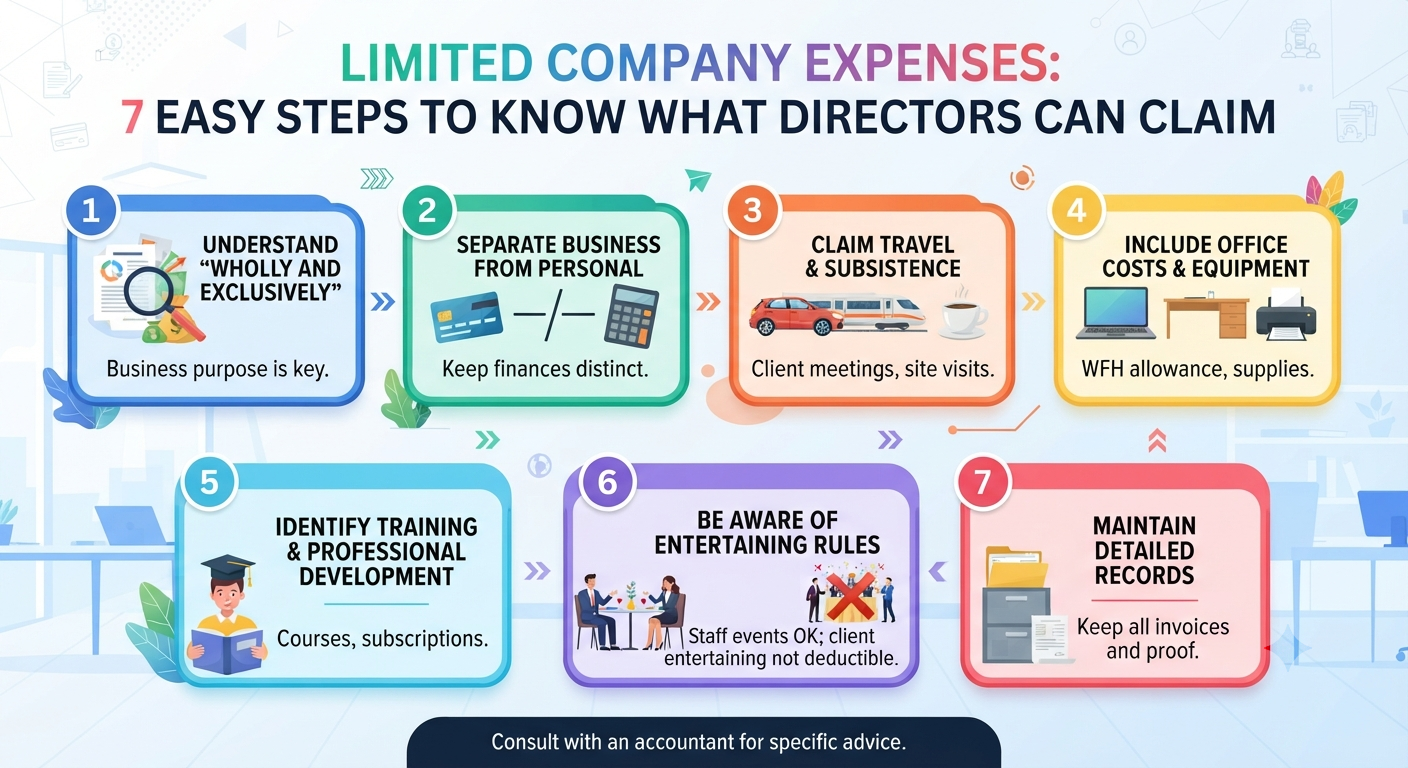
Limited Company Expenses: 7 Easy Steps for Directors
Quick Summary
Running a limited company comes with many costs, from office supplies and software to business travel, professional fees, insurance, and other operating expenses.
But an important question for directors is:
What expenses can a limited company actually claim?
The answer depends on the type of expense, why it was incurred, how it was paid, and whether it meets the relevant tax rules.
A limited company is a separate legal entity from its directors. This means company expenses should be recorded separately from personal spending.
HMRC states that limited companies may be able to deduct some costs of running the business when calculating taxable profit for Corporation Tax. Whether a cost is deductible depends on factors including whether it is a capital or revenue expense and whether it has a business purpose.
In this guide, we’ll explain 7 easy steps to help directors understand:
- What limited company expenses are
- Which common business expenses may be claimable
- How director expenses work
- What happens when a director pays personally
- Which expenses need extra care
- Which costs are generally not allowable
- How to keep proper expense records
- When professional accounting advice may be useful
Important: This article provides general information about UK limited company expenses. Tax treatment can depend on the specific facts and circumstances. Always check current HMRC guidance or speak with a qualified accountant or tax professional before making a tax claim.
Key Takeaways
- Limited companies can claim certain business costs when calculating taxable profit.
- The purpose of the expense is important.
- Business expenses should be kept separate from personal spending.
- Directors can sometimes pay business expenses personally and have the company reimburse them.
- Travel and mileage expenses have specific rules.
- Business meals and entertainment require particular care.
- Some expenses may be taxable benefits rather than ordinary business expenses.
- Client entertaining is generally not deductible for Corporation Tax purposes.
- Accurate receipts and records are important.
- Capital expenses may be treated differently from ordinary revenue expenses.
- Not every expense paid by the company automatically becomes an allowable tax deduction.
- When you’re unsure, professional advice can help prevent costly mistakes.
Quick Answer: What Expenses Can Directors Claim Through a Limited Company?
A director may be able to have the company pay or reimburse legitimate business expenses that are incurred in connection with the company’s activities.
Common examples can include:
- Business travel
- Mileage for qualifying business journeys
- Office costs
- Business software
- Professional subscriptions
- Accounting fees
- Legal and professional fees
- Business insurance
- Telephone and internet costs where applicable
- Certain home-working costs
- Business equipment
- Work-related training
- Certain business meals and accommodation
- Advertising and marketing
- Company formation and administration costs where applicable
However, the fact that a company pays for something does not automatically mean the cost is tax-deductible.
HMRC specifically notes that companies need to consider whether an expense is a capital or revenue expense and whether it has a business purpose.
That’s why directors should understand the difference between:
Company payment → Accounting treatment → Tax treatment
These are not always exactly the same thing.
Who Is This Guide For?
This guide is designed for:
- Limited company directors
- Owner-managed companies
- Small business owners
- Company directors who pay expenses personally
- New limited company owners
- Freelancers operating through a limited company
- Contractors using limited companies
- Directors who work from home
- Small companies with employees
- Business owners who want better expense records
If you’re asking “Can I claim this through my limited company?”, this guide gives you a practical framework for thinking about the expense.
Introduction
One of the advantages of operating through a limited company is that the company can pay legitimate business costs.
But expenses can also become confusing.
A director might pay for a business lunch with a personal card.
Another director might purchase a laptop for company work.
Someone else might work from home and pay part of their household costs.
Another business owner might travel to meet a client.
The question in each case is:
Can the company pay or reimburse the cost, and how should it be treated for tax purposes?
There isn’t one simple answer for every expense.
HMRC’s guidance explains that limited companies may deduct some business-running costs when calculating taxable profit, but the rules depend on the nature and purpose of the expense.
That’s why having a consistent expense process is so important.
7 Easy Steps to Know What Directors Can Claim
Step 1: Understand What Counts as a Limited Company Expense
The first step is understanding what a business expense actually means.
In simple terms, a company expense is a cost connected with running the business.
Examples might include:
- Office rent
- Business insurance
- Accounting software
- Advertising
- Website costs
- Professional services
- Business equipment
- Business travel
- Telephone services
- Work-related software
- Training
- Certain professional memberships
But not every cost connected loosely to the director’s life is a company expense.
For example, a personal holiday is not automatically a business expense simply because the director checks emails while away.
The purpose and circumstances matter.
Business Purpose Matters
HMRC explains that one of the key considerations for company expenses is whether the expense has a business purpose.
Ask:
“Would the company have incurred this cost for a genuine business reason?”
If the answer is clearly yes, the expense may potentially qualify.
If the expense is primarily personal, extra care is needed.
A Simple Test
Before recording an expense, ask:
- Who incurred the expense?
- Why was it incurred?
- Was it connected to the business?
- Is there supporting documentation?
- Is it revenue or capital?
- Are there specific tax rules for this type of expense?
This simple process can prevent many bookkeeping problems.
Step 2: Know the Common Expenses a Limited Company May Claim
There are many ordinary costs that a company may incur while operating.
Let’s look at some common categories.
Office Expenses
Depending on the circumstances, a company may have expenses such as:
- Stationery
- Printing
- Postage
- Office furniture
- Office equipment
- Business software
- Computer equipment
- Office rent
- Business-related supplies
The exact tax treatment depends on the individual expense.
Software and Subscriptions
Modern businesses often use software every day.
Potential business software costs can include:
- Accounting software
- Project management tools
- Cloud storage
- Design software
- CRM systems
- Website software
- Cybersecurity software
- Communication platforms
If the software is genuinely used for business purposes, it may be a legitimate company cost.
Professional Fees
Professional services can also be an important company expense.
Examples include:
- Accounting fees
- Bookkeeping fees
- Legal fees
- Business consultancy
- Professional advice
- Certain professional subscriptions
The specific tax treatment depends on the service and circumstances.
Marketing and Advertising
A company may also incur costs to promote its business.
Examples include:
- Website development
- Online advertising
- Printed marketing materials
- Business cards
- Promotional campaigns
- Search engine optimisation
- Social media advertising
- Photography for business marketing
These costs should be properly documented and connected to the business.
Business Insurance
Companies may need various forms of business insurance.
Depending on the business, this could include:
- Professional indemnity insurance
- Public liability insurance
- Employer-related insurance
- Business equipment insurance
- Other commercial insurance
The exact treatment depends on the policy and circumstances.
Step 3: Understand Director Travel and Mileage Expenses
Travel is one of the areas where directors often have questions.
A director may travel for genuine business reasons, such as:
- Visiting a client
- Attending a business meeting
- Travelling to a temporary workplace
- Attending a business event
- Visiting a supplier
- Attending certain work-related training
However, not every journey qualifies as business travel.
There are specific rules surrounding travel expenses and directors. HMRC’s guidance includes dedicated rules for directors’ travel expenses and deductions.
Mileage
If a director uses their own vehicle for qualifying business journeys, mileage rules may apply.
The treatment depends on factors such as:
- The type of journey
- The vehicle
- Whether the company reimburses the director
- The applicable mileage rules
- The tax year
For this reason, directors should avoid simply treating every journey as business mileage.
Keep a Mileage Record
A useful mileage record can include:
| Information | Example |
|---|---|
| Date | 15 September 2026 |
| Destination | Client office |
| Business purpose | Client meeting |
| Starting mileage | 24,100 |
| Ending mileage | 24,145 |
| Business miles | 45 |
Keeping this information consistently makes expense processing much easier.
Step 4: Know What Happens When Directors Pay Personally
A common situation is:
The director pays for something personally → The expense belongs to the company → The company reimburses the director.
For example, imagine a director purchases £300 of business software using a personal credit card.
If the cost genuinely relates to the company, the company may record the appropriate expense and reimburse the director, subject to the applicable rules.
This is why directors should keep:
- Receipts
- Invoices
- Payment records
- Business purpose
- Dates
- Supplier details
- Supporting documentation
Don’t Just Transfer Random Amounts
A common mistake is transferring money from the company account to the director without recording why.
Instead, maintain a clear record showing:
Expense → Evidence → Accounting entry → Reimbursement
This makes the company’s records much easier to understand.
Step 5: Understand Meals, Entertainment and Business Hospitality
Meals and entertainment are areas where directors need to be particularly careful.
A meal connected to business activity does not automatically mean it is tax-deductible.
HMRC has specific rules covering expenses and benefits involving employees and directors.
Business Meals
The tax treatment can depend on:
- Why the meal took place
- Who attended
- Whether it was part of business travel
- Whether employees were involved
- Whether clients were present
- Whether the expense is treated as a benefit
- The applicable exemption or reporting rules
Client Entertainment
This is especially important.
HMRC states that some expenses, including entertaining clients, are specifically disallowed for Corporation Tax purposes.
So:
Company pays for something ≠ Automatically Corporation Tax deductible
This distinction is extremely important.
Staff Functions
Staff events can have different rules from client entertaining.
Certain employee functions may qualify for specific tax treatment if the relevant conditions are met.
Because the rules can depend on the circumstances, directors should check the current HMRC guidance before assuming that a meal or event is tax-free.
Step 6: Separate Allowable Expenses From Personal Costs
One of the biggest mistakes directors can make is treating personal spending as a business expense.
A limited company is a separate legal entity.
The fact that you own the company does not mean the company’s money is automatically your personal money.
Examples of Clearly Personal Costs
Generally, expenses such as these require caution:
- Personal holidays
- Personal shopping
- Household groceries
- Private entertainment
- Personal subscriptions
- Family expenses
- Personal debts
- Private travel
- Non-business purchases
If the company pays a personal cost, it may need to be treated differently in the accounts and could potentially create tax or reporting consequences.
HMRC guidance specifically addresses expenses and benefits provided to directors and employees, including situations where payments may be taxable benefits.
Ask This Question
Before claiming an expense, ask:
“Would I have incurred this cost if I were not running this business?”
If the answer is yes because it is primarily personal, don’t automatically classify it as a business expense.
Step 7: Keep Accurate Records for Every Expense
Even when an expense appears obvious, good records matter.
HMRC advises companies to keep accurate and detailed business records when determining whether expenses can be deducted.
Your records might include:
- Receipts
- Invoices
- Bank statements
- Credit-card statements
- Mileage logs
- Expense claims
- Supplier invoices
- Contracts
- Business purpose notes
- Payment confirmations
What Should an Expense Record Include?
A good expense record can show:
Date + Supplier + Amount + Business Purpose + Payment Method + Supporting Evidence
For example:
| Date | Supplier | Amount | Purpose |
|---|---|---|---|
| 10 Sep 2026 | Software Provider | £49 | Business accounting software |
| 12 Sep 2026 | Train Operator | £85 | Client meeting |
| 15 Sep 2026 | Office Supplier | £120 | Business stationery |
This makes bookkeeping much easier.
Common Limited Company Expenses Directors Should Know
Let’s look at some of the most common categories.
1. Accountancy and Bookkeeping Fees
If your company hires an accountant or bookkeeper for legitimate company-related work, those costs may be business expenses.
This can include:
- Bookkeeping
- Accounts preparation
- Payroll support
- Tax-related services
- Accounting software setup
- Financial reporting
The exact treatment depends on the service provided.
2. Business Insurance
Insurance related to the company’s business activities can be an important operating cost.
Examples may include professional indemnity or public liability insurance.
Keep the policy documentation and payment records.
3. Advertising and Marketing
Marketing expenses can include:
- Google advertising
- Social media advertising
- Website costs
- SEO services
- Graphic design
- Printing
- Promotional materials
Keep invoices and evidence of the business purpose.
4. Website Costs
A company website may involve:
- Domain registration
- Hosting
- Website development
- Maintenance
- Security
- Plugins
- Business email
The accounting and tax treatment can vary depending on what has been purchased.
5. Telephone and Internet
Business-related communication costs may be claimable depending on how the service is used and structured.
Where personal and business use are mixed, the appropriate treatment should be considered rather than automatically claiming the entire bill.
6. Professional Memberships
Certain professional memberships and subscriptions can potentially qualify where they relate to the director’s or company’s business activities.
Check the relevant rules before claiming membership costs.
7. Training and Development
Work-related training may be a legitimate business cost where it is relevant to the business.
Examples might include:
- Professional courses
- Industry training
- Skills development
- Business-related conferences
- Technical training
The purpose of the training matters.
8. Business Equipment
Companies may purchase equipment such as:
- Laptops
- Monitors
- Printers
- Office furniture
- Cameras
- Tools
- Business machinery
However, equipment may be treated as a capital expense rather than an ordinary revenue expense.
This distinction can affect how the cost is treated for tax purposes. HMRC specifically advises companies to consider whether an expense is capital or revenue.
What Expenses Are Usually Not Claimable?
Not every expense is allowable.
Some common examples that require caution include:
- Personal expenses
- Private holidays
- Personal shopping
- Client entertainment for Corporation Tax purposes
- Costs with no genuine business purpose
- Private elements of mixed-use expenses
- Certain fines and penalties
- Personal living expenses
The treatment of an expense can depend on the circumstances, so avoid using a simple “everything business-related is deductible” rule.
Can a Director Claim Home Office Expenses?
Many directors work from home, particularly in small companies.
Home-working expenses can be more complicated than they first appear.
Potentially relevant costs may include:
- Certain additional household costs
- Business telephone costs
- Business internet costs
- Office equipment
- Certain home-working arrangements
However, the exact treatment depends on how the expense is incurred and the applicable rules.
A director should not automatically claim a percentage of every household bill simply because they work from home.
Before claiming home-working costs, consider:
- Is the expense genuinely related to working from home?
- Is there a private element?
- Is the company reimbursing the director?
- Is there a specific exemption?
- Is the expense being claimed by the company or director?
- Does the arrangement create any benefit-in-kind issue?
Can a Limited Company Pay for a Director’s Phone?
Potentially, yes, depending on the arrangement and the rules that apply.
A business may need telephone services for:
- Client calls
- Supplier communication
- Business emails
- Customer support
- Business messaging
- Two-factor authentication
- Remote working
However, personal use can affect the treatment.
The safest approach is to keep a clear record of what the company is providing and how it is being used.
Can a Limited Company Pay for a Director’s Laptop?
A company can purchase equipment for business use.
A laptop may be a legitimate business purchase if it is genuinely required for company activities.
However, the tax treatment can depend on:
- Business use
- Private use
- Ownership
- Cost
- Whether it is capital expenditure
- How the company provides the equipment
Don’t assume that purchasing an expensive item through the company automatically creates a full tax deduction.
Can Directors Claim Business Travel Expenses?
Potentially, yes.
Business travel is subject to specific rules.
A director may incur expenses for:
- Train travel
- Bus travel
- Flights
- Taxis
- Hotels
- Qualifying mileage
- Certain subsistence costs
The reason for the journey matters.
HMRC’s guidance contains specific rules covering travelling and subsistence expenses for directors and employees.
Can Directors Claim Meals While Travelling for Business?
Potentially, but specific conditions can apply.
The treatment can depend on:
- Whether the travel is qualifying business travel
- The location
- Duration of the trip
- Whether the meal is reasonable
- Whether the expense is reimbursed
- Whether an exemption applies
Meals and benefits provided to directors and employees can have separate tax and reporting rules.
Keep the receipt and record the business reason for the journey.
What About Client Entertainment?
Client entertainment is one of the most commonly misunderstood expenses.
A company may decide to pay for:
- A client meal
- Event tickets
- Hospitality
- Drinks
- Entertainment
But that doesn’t necessarily mean the company gets a Corporation Tax deduction.
HMRC specifically identifies client entertaining as an example of an expense that cannot be deducted when calculating taxable profit for Corporation Tax.
Therefore:
Business expense ≠ Automatically tax-deductible expense
This distinction should be reflected correctly in the accounts.
What About Employee Entertainment?
Employee events can have different rules.
For example, certain staff functions may qualify for specific exemptions when the relevant conditions are met.
However, the details matter.
HMRC’s guidance explains that the tax treatment of meals and employee benefits depends on factors including where the meal occurs, who receives it, how it is provided, and whether an exemption applies.
Always check the current rules before assuming a staff event is exempt.
What Is the Difference Between an Expense and a Benefit?
This distinction is important.
An expense is generally a cost connected with business activity.
A benefit is something provided to a director or employee that may have personal value.
For example, if a company provides something that is primarily for the director’s personal benefit, different tax and reporting rules may apply.
HMRC’s employer guidance explains that employers providing expenses or benefits to employees or directors may have reporting and tax obligations depending on the specific benefit.
So directors should ask:
Is this a business expense, a taxable benefit, or a mixture of both?
Director Expenses vs Company Expenses
These terms can sometimes cause confusion.
A director may personally incur a cost on behalf of the company.
For example:
Director pays £100 personally → Company owes director £100 → Company reimburses director
That doesn’t necessarily mean the expense is a personal expense.
The underlying purpose of the purchase is what matters.
If the purchase was genuinely for the company, the accounting records should reflect that.
Can a Director Pay Company Expenses Personally?
Yes, this can happen frequently in small companies.
For example, a director might use a personal card to pay for:
- Software
- Business travel
- Stationery
- Professional fees
- Equipment
The company can then reimburse the director where appropriate.
The key is documentation.
Keep:
- Receipt
- Invoice
- Date
- Amount
- Business purpose
- Payment evidence
This helps the accountant or bookkeeper record the transaction correctly.
What Happens If the Company Pays a Personal Expense?
This is where directors need to be careful.
If a company pays a cost that is genuinely personal to the director, it should not simply be labelled as an ordinary business expense.
Depending on the circumstances, it may need to be treated as:
- A director’s loan
- Remuneration
- A taxable benefit
- Another appropriate accounting treatment
HMRC guidance specifically addresses situations where company-paid expenses or benefits can create tax and reporting obligations for directors and employees.
This is one reason why directors should not mix personal and company spending.
Capital Expenses vs Revenue Expenses
Another important distinction is between capital expenditure and revenue expenditure.
Revenue Expenses
These are generally ordinary operating costs associated with running the business.
Examples may include:
- Advertising
- Office supplies
- Software subscriptions
- Professional fees
- Insurance
Capital Expenses
These can relate to acquiring or improving assets that provide longer-term value.
Examples may include:
- Major equipment
- Machinery
- Certain property-related costs
- Long-term business assets
HMRC says companies need to determine whether an expense is capital or revenue when considering Corporation Tax deductions.
The distinction can affect how the expenditure is treated.
Common Mistakes Directors Make With Expenses
Mistake 1: Treating Every Company Payment as Tax-Deductible
A company paying for something doesn’t automatically make it deductible.
Mistake 2: Mixing Personal and Business Expenses
This makes bookkeeping more difficult and can create tax complications.
Mistake 3: Losing Receipts
Without supporting documentation, it can become difficult to prove the nature and purpose of an expense.
Mistake 4: Claiming Private Costs as Business Expenses
Personal expenses should not simply be classified as business costs.
Mistake 5: Ignoring Capital vs Revenue Treatment
Large equipment purchases may need different accounting and tax treatment.
Mistake 6: Treating Client Entertainment as Deductible
Client entertaining is specifically identified by HMRC as a disallowed Corporation Tax deduction.
Mistake 7: Forgetting About Benefits
Some company-provided items or payments can create taxable benefits or reporting obligations.
Simple Director Expense Checklist
Before submitting an expense, ask:
- ☐ Is it genuinely related to the company?
- ☐ Do I have a receipt?
- ☐ Do I have an invoice where appropriate?
- ☐ Have I recorded the business purpose?
- ☐ Was it paid personally or by the company?
- ☐ Does it contain any private element?
- ☐ Is it a capital or revenue expense?
- ☐ Are there specific rules for this type of expense?
- ☐ Could it be a taxable benefit?
- ☐ Does it need separate tax treatment?
- ☐ Have I recorded it in the accounting system?
If you’re unsure about any of these questions, ask your accountant before claiming the expense.
How to Keep Better Limited Company Expense Records
A simple system can make expense management much easier.
Step 1: Use a Business Bank Account
Keep company transactions separate from personal spending.
Step 2: Keep Receipts Digitally
Store receipts and invoices electronically where appropriate.
Step 3: Record Expenses Regularly
Don’t wait until the end of the financial year.
Step 4: Categorise Expenses Correctly
Use appropriate accounting categories.
Step 5: Record Personal Expenses Separately
Don’t mix personal costs with legitimate business expenses.
Step 6: Reconcile Regularly
Compare your accounting records with bank and card statements.
Step 7: Review Unusual Expenses
If something doesn’t fit your normal expense pattern, investigate it before submitting it.
How Accounting Software Can Help
Accounting software can make expense management easier.
Depending on the platform, you may be able to:
- Upload receipts
- Categorise transactions
- Reconcile bank accounts
- Track expenses
- Record mileage
- Create reports
- Manage invoices
- Share records with your accountant
But software doesn’t replace judgment.
The system can record a transaction, but you still need to determine whether it has been categorised and treated correctly.
When Should a Director Speak to an Accountant?
Professional advice can be especially useful when:
- You’re unsure whether an expense is allowable
- You have a large unusual purchase
- You’re buying property or equipment
- You’re claiming significant travel expenses
- You’re providing benefits to directors
- You’re paying personal expenses through the company
- You’re employing staff
- You’re dealing with entertainment expenses
- Your company is growing
- You’re unsure about tax reporting requirements
HMRC itself advises businesses to speak with an accountant or agent when they need help determining whether expenses are capital or revenue and how they should be treated.
Limited Company Expenses: A Simple Example
Imagine a director runs a digital marketing company.
During September, the company incurs:
| Expense | Amount | General Category |
|---|---|---|
| Accounting software | £40 | Software |
| Business insurance | £70 | Insurance |
| Website hosting | £30 | Website |
| Train to client meeting | £85 | Business travel |
| Office supplies | £50 | Office |
| Personal shopping | £120 | Personal |
| Client dinner | £150 | Entertainment |
The director shouldn’t simply enter all seven transactions as tax-deductible business expenses.
Instead, each item should be reviewed based on its purpose and the relevant tax rules.
For example, client entertainment can be a business cost in the accounts but is specifically disallowed as a Corporation Tax deduction under HMRC guidance.
The personal shopping is not transformed into an allowable company expense merely because the company paid for it.
This example shows why recording an expense and determining its tax treatment are two separate steps.
What Directors Should Do Before Claiming an Expense
Use this five-question test:
1. Is It Business-Related?
If not, stop and investigate the treatment.
2. Do You Have Evidence?
Keep the receipt or invoice.
3. Is There a Private Element?
If yes, determine the appropriate treatment.
4. Are There Special Rules?
Travel, meals, benefits, entertainment, vehicles and other areas can have specific rules.
5. Is the Tax Treatment Clear?
If you’re unsure, ask a qualified professional.
Frequently Asked Questions About Limited Company Expenses
What expenses can a limited company claim?
A limited company may be able to deduct certain costs of running its business when calculating taxable profit. Common business costs can include office expenses, software, professional fees, insurance, advertising and qualifying business travel. The exact tax treatment depends on the nature and purpose of the expense.
Can directors claim expenses through their limited company?
Directors can incur and be reimbursed for legitimate business expenses, subject to the relevant rules. Directors should keep appropriate records and evidence for expenses they pay personally.
Can a director claim mileage?
Potentially. Qualifying business mileage is subject to specific rules, and directors should maintain appropriate mileage records. HMRC provides specific guidance on mileage and directors’ travel expenses.
Can a limited company pay for a director’s meals?
Potentially, depending on the circumstances. Meals can have different tax and reporting treatments depending on why they were provided, who attended and where the meal took place.
Can a limited company claim client entertainment?
A company may incur client entertainment costs, but HMRC states that entertaining clients is specifically disallowed as a Corporation Tax deduction.
Can a director claim expenses paid personally?
A director may pay legitimate company expenses personally and seek reimbursement from the company. The expense should be properly documented and recorded.
Can a limited company pay personal expenses?
A company paying a director’s personal expense does not automatically make it an allowable business expense. Depending on the circumstances, it may need to be treated as a benefit, remuneration, director’s loan or another appropriate accounting treatment.
Can I claim home office expenses through my limited company?
Potentially, but home-working expenses can involve specific rules. The appropriate treatment depends on the arrangement, the expense and whether there is any private use.
Can my company pay for my laptop?
A company can purchase equipment for business purposes, but the tax treatment may depend on factors such as business use, private use and whether the purchase is capital expenditure.
Can my company pay for my phone?
Potentially, depending on how the phone and contract are structured and how they are used. Personal use can affect the tax treatment.
Are accounting fees a company expense?
Professional accounting and bookkeeping services can be legitimate business costs where they relate to the company’s activities. The specific tax treatment depends on the service provided.
Are business insurance costs deductible?
Business insurance can be a legitimate operating expense, depending on the nature of the policy and the business activity.
Can I claim business software?
Software used for genuine business purposes can generally be recorded as a company cost, but the tax treatment can depend on the nature of the software and how it is purchased.
Can a limited company claim training costs?
Work-related training may be a business expense where it is relevant to the company’s activities and meets the applicable rules.
What records should directors keep for expenses?
Keep receipts, invoices, payment records, dates, amounts, suppliers and a clear explanation of the business purpose. HMRC advises companies to keep accurate and detailed business records.
What is the difference between a company expense and a taxable benefit?
A company expense is generally a cost associated with business activity. A benefit is something provided to a director or employee that may have personal value. Benefits can have separate tax and reporting rules.
Do all company expenses reduce Corporation Tax?
No. Not every expense paid by a company is automatically deductible for Corporation Tax. HMRC specifically identifies some expenses as disallowed, including client entertaining.
Should directors keep personal and company expenses separate?
Yes. Keeping business and personal spending separate makes bookkeeping easier and helps ensure expenses are recorded and treated correctly.
2026 Limited Company Expense Checklist
Before the end of each month, directors can review:
- ☐ Business bank transactions
- ☐ Company credit-card transactions
- ☐ Director-paid expenses
- ☐ Receipts
- ☐ Invoices
- ☐ Mileage records
- ☐ Business travel
- ☐ Software subscriptions
- ☐ Professional fees
- ☐ Insurance
- ☐ Marketing costs
- ☐ Office expenses
- ☐ Equipment purchases
- ☐ Employee expenses
- ☐ Entertainment expenses
- ☐ Benefits provided to directors or employees
- ☐ Personal expenses incorrectly charged to the company
- ☐ Unusual or large transactions
- ☐ Capital expenditure
Regular reviews can make year-end accounting much easier.
Final Verdict: What Can Directors Claim Through a Limited Company?
Understanding limited company expenses doesn’t have to be complicated.
The key is to avoid thinking:
“Can the company pay for this?”
Instead, ask:
“Why was this expense incurred, who benefited from it, and how should it be treated for accounting and tax purposes?”
A legitimate business expense may be deductible, but the rules depend on the type and circumstances of the expense.
The 7-step approach is:
- Understand the expense
- Confirm the business purpose
- Check the specific rules
- Separate business and personal costs
- Record director-paid expenses properly
- Check for benefits, entertainment and special treatment
- Keep accurate supporting records
The most important thing is consistency.
Keep your company and personal finances separate, retain supporting documents, record expenses regularly, and don’t assume that every company-paid cost is tax-deductible.
When an expense is unusual, significant, or unclear, getting professional advice can help you avoid incorrect claims and unexpected tax consequences.
Good expense management = Better records + Clearer accounts + Fewer surprises.
For current UK tax treatment, always check the latest HMRC guidance because expense rules and reporting requirements can change. HMRC’s current guidance covers expenses and benefits for directors and employees, including travel, meals, benefits and reporting requirements.